
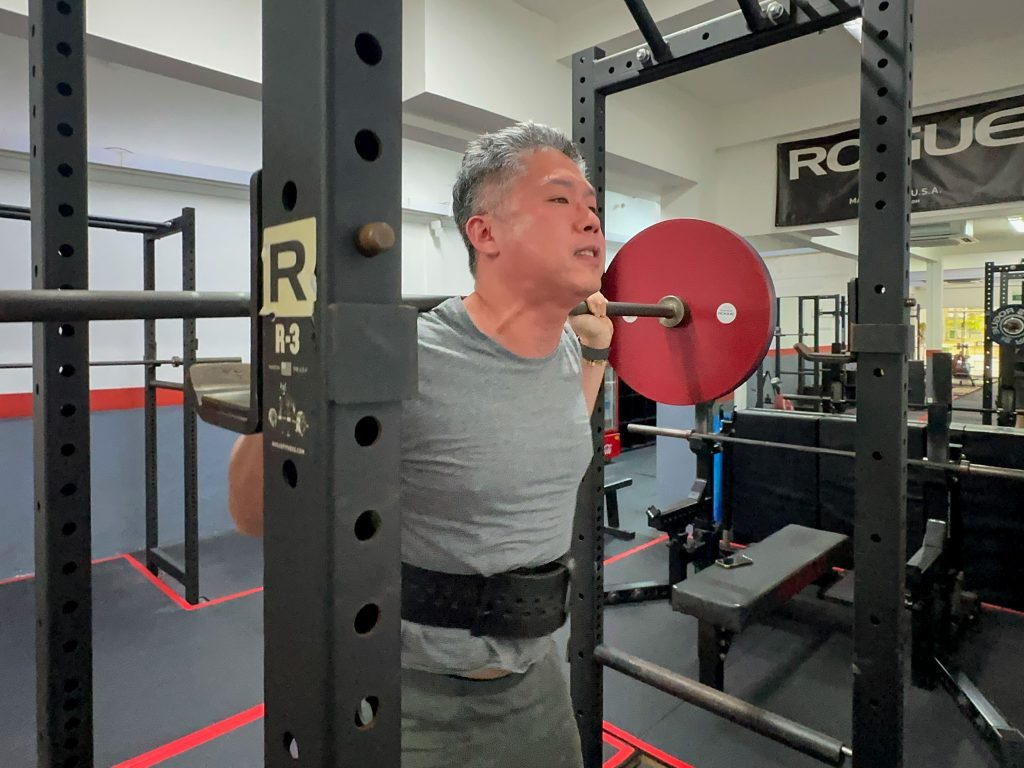
Over the years of coaching and training, I’ve learnt many things. One thing that tends to come up on a regular basis is: how you feel when you train is a lie. And if you allow it, that lie usually causes you to shortchange yourself.
Your feelings mislead you in two main ways. First: you think you can’t perform today – you didn’t sleep well, you’re tired, not feeling 100%. So you want to go lighter than programmed before training even starts. Second: you overestimate how hard the rep or set feels – you rack the bar early. You avoid going up in weight. You select conservative attempts. All because your brain is telling you that there’s no way that you can do more.
Both are avoidable if you try first and trust objective feedback over your feelings and remember that your limits aren’t where you think they are.
Let’s start with the first lie: the belief that you can’t train hard today.
Lie #1: “I’m tired/unwell/jetlagged, so I can’t train hard today”
A few days before I wrote this article, a client came in and told me her stomach was feeling funky and had GI issues earlier in the day. She asked if we could reduce the weight for that day’s training. I gave my usual response: “Let’s try warming up first and see how you feel. If you don’t feel good along the way, we can adjust.” As she warmed up, she felt fine. All the way to her prescribed working weights. She completed training with no adjustment and no issues.
This happens from time to time. A client requests to go lighter because they’re tired, didn’t sleep well, are jet-lagged, or are not feeling well. Our response is always: “Let’s try and see. We can adjust as needed as we go along, but let’s try first.”
More often than not, the client performs better than they expect and leaves the gym feeling better than when they walked in. And that’s with completing the session as programmed without any adjustment. This morning, another client summed it up perfectly: “Before training, I dread coming. During training, I regret coming. After training, I’m glad I came.”
The principle is simple: try first, adjust as needed. Don’t surrender to how you feel before you even start your first warm up. We’ve had clients plan to attempt a PR, come in “not feeling great” because they were tired, and still hit it. We’ve also had clients come in feeling awesome and motivated for a new PR… and didn’t get it because it just wasn’t there that day. But both wouldn’t have known until they tried.
With that being said, if you have a sense that your performance really isn’t there that day as you warm up or do your work sets, don’t blindly keep pushing and grind out every set. That’s not wise. Make a judgement call and adjust downwards.
So should you always try to train, see how you feel and then adjust? Of course not. There are situations when it’s a bad idea to train. In general, if you’ve got body or joint aches, chills, or a fever, don’t train. Rest.
Lie #2: “This felt super hard – I can’t do another rep or increase the weight the next time”
The next feeling you shouldn’t trust is how hard the rep or set feels. It always feels harder than it actually is as there’s a disconnect between subjective effort and objective performance, likely due to discomfort aversion.
So you shortchange yourself. You rack the bar on rep four because you think you can’t do another, rather than attempt the fifth rep. Or your last warmup before a PR attempt feels super hard, so you select a conservative weight.
It’s common to have clients tell us after a set that it felt super hard and that they don’t know how they can do another, or that it felt much heavier than usual today. They never believe us when we tell them the set looks just fine and wasn’t really that tough. I’ll tell them that it always feels harder than it feels, and offer to video their next set. When they watch the footage, they’re always surprised that it looks much easier and the bar speed was faster than what they felt. “It doesn’t feel like that at all,” they always say.
I tell them it’s normal. If you could observe yourself lifting from a third-person perspective, you’d agree it looks fine and doable. But ask the first-person their perspective on how it felt, and they’ll say it feels heavy and hard.
Even I still occasionally fall victim to this, and I’ve been training for a long time. The number of times I’ve felt a set was hard and slow because I was tired or didn’t sleep well the night before, only to watch the video and surprise myself – it was actually much easier than it felt.
How will this affect your progress
Let’s say you’re programmed for a set of 5. On rep #4, it feels pretty hard to get back up. After fighting to get back up, you’re standing there thinking: “Damn, that was super hard. Can I really get one more? Should I try or rack it?”
If you rack it, you’re potentially missing one more successful rep. No matter how it feels, you have to attempt it. If you get the rep, awesome. If you miss, fine. At least you tried.
Another way this shows up: you’re a couple of months into training and today’s workout felt really hard. You think: “Can I really go up in weight next time?” This tends to happen to new lifters on the Novice Linear Progression (NLP). Because the weight goes up every session and they’re new to training, it feels hard. Without much experience under their belt, they don’t have a good grasp on what really hard feels like. So they either make the mistake of staying at the same weight until it feels easier (spoiler: it doesn’t) or prematurely change to a more advanced programme. They then wonder why they’re not making any progress – lifting the same weight and looking the same after years of training.
As you get stronger, training gets harder. It will feel hard. That’s just part of the deal. Yes, life will get in the way and make it harder to adhere to the process. Work stress. Not sleeping well. But if you want to get stronger, you’ll need to progressively add weight to your bar over time even if you don’t feel like it, and then lift it. Are you able to lift it? Only one way to find out. Because when you try, you learn. You learn to keep going even when it’s hard. You learn where your limits are or aren’t. None of that happens if you don’t even try.
The solution: Objective feedback over feelings
To continue making progress over the long term, you’ll find that using objective feedback instead of “feels” to make programming decisions will yield you the results that you want.
This is when a coach comes in handy. An experienced coach provides objective feedback by observing your training, taking into account a multitude of factors and then making appropriate decisions for your programming.
If you train alone, video your sets and watch them as soon as you can after completing the set. Compare what you felt to what you see. Over time, you’ll learn to recognise that the rep that felt like a grinder wasn’t that hard after all. You’ll see your form held when you were sure it was breaking down. You can also write down how you felt in your training log to correlate the data.
Critically, set up your safeties properly. They’re not optional. If you’re pushing hard, you need to ensure that you’re safe in the event of a missed rep. Safeties allow you to try for that rep that you’re on the fence about safely, instead of quitting early out of fear.
Trust the process, not the feeling
If you’ve ever videoed yourself lifting and watched it, you’ll know what I’m talking about when I say that how you feel is usually a lie. So instead of relying on how it feels, use quantitative feedback to make decisions regarding your training, and you’ll find that it’s a much better use of your time in the gym.