
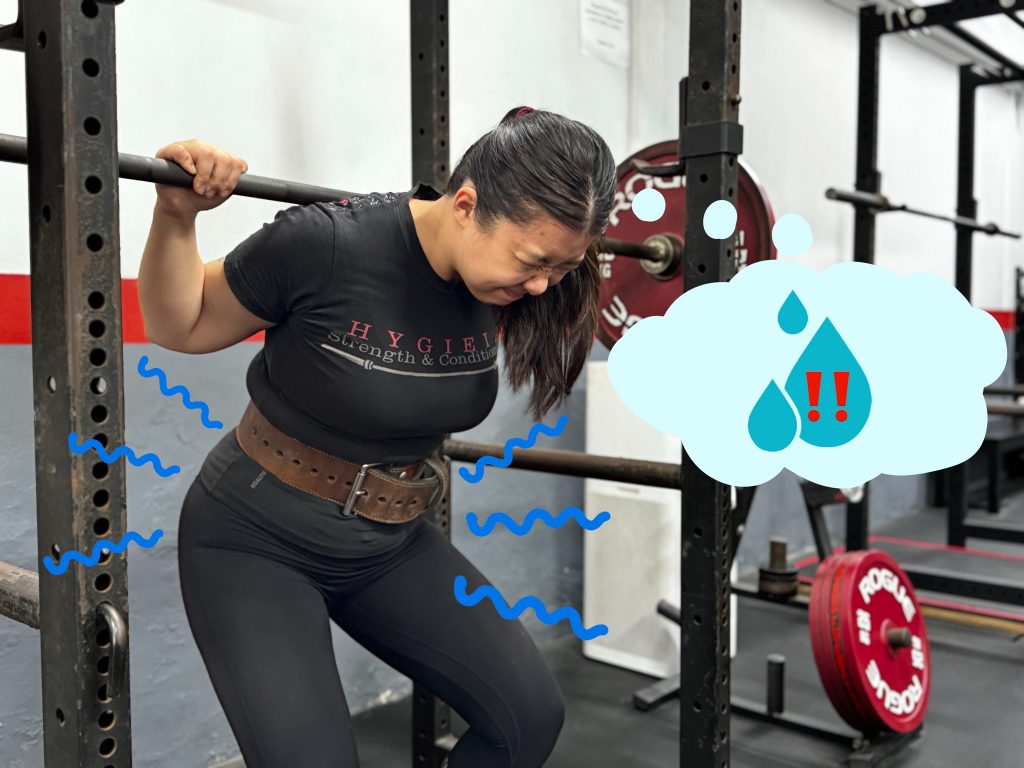
The way I treated my body during the bulk of my late twenties sounds measurably more physically stressful than my current life. Despite working long hours at the restaurant, I was busy living in the most hedonistic manner possible in between shifts, filling my time with dinners, parties, and late nights, all while indulging in every (legal) vice I could get my hands on. On top of that, I barely exercised. Whenever I look back on that period, I often wonder where I found that seemingly endless supply of energy to sustain such a lifestyle day after day.
Yet now, with a lifestyle that seems to be the complete opposite – being at the gym four days a week, eating mostly self-cooked meals, maintaining a decent sleep score, and living in complete sobriety – one would assume that my body should be responding similarly in kind, right?
Not to sound like an ageist or a hypochondriac, but I have been noticing more changes in my body as I approach my mid-thirties. To name a few, my body has decided to stop being efficient at digesting alcohol, and I developed a skin allergy related to heat stress. I’ll be honest, these are seemingly trivial issues with relatively straightforward solutions — abstinence and antihistamines solved these problems easily. None of them bothered me as long as they leave my training alone. Until some time ago, I started noticing occasional urinary incontinence (UI) while squatting heavy, an issue that affected and inconvenienced me for much longer than I’d readily admit.
How It Got Worse
At first, I would leak only on the days that I pushed myself past my limit. Yes, the days when I left my ego unchecked and just wanted that extra kilo on my personal best. In a bid to keep the symptoms to a minimum, I did some research and made a few training adjustments. I switched to a narrower belt that fit me better during the squat and adjusted it slightly higher so it wouldn’t press directly against my bladder. I continued training hard and remained mostly symptom-free for another year, with rare instances of light bladder breaching occurring only once every few months.
I thought the issue had been kept at bay until I developed a series of urinary tract infections last year.
It turned out that the antibiotics initially prescribed were not effective against the strain causing the repeated infections, which resurfaced every two to three months. Between reinfections, I also began experiencing more frequent episodes of lifting-related UI, even on lighter training days. At first, it affected only my squat, but soon I started feeling the urge to release during deadlifts and presses as well. Whenever I needed to brace hard, I felt the need to go.
On the bright side, I otherwise felt completely in control of my bladder whenever I wasn’t under the bar.
Fast forward through the correct course of antibiotics, several tests, an MRI, and multiple visits to urologists, and I’m thankful that I was dealing with nothing more than an unfortunate series of infections. There was no sign of pelvic floor damage, but my confidence under the bar remained so low that lifting anything “heavy enough” would trigger fears of leaking.
At this stage, I decided to dive deeper in search of solutions that would help me get back on track with my training while managing the anxiety I had developed around lifting heavy.
What Exactly Is Female Urinary Incontinence?
Through my research, I learnt that female urinary incontinence is not a disease in itself, but a symptom involving the involuntary loss of bladder control. Depending on the underlying cause, it can present in different ways [1]:
• Stress incontinence: leakage that occurs when pressure is placed on the bladder, such as during coughing, sneezing, laughing, jumping, or lifting.
• Urge incontinence: a sudden, intense urge to urinate that results in leakage before reaching the toilet.
• Overflow incontinence: leakage caused by the bladder being unable to empty fully.
These symptoms can arise from a wide range of contributing factors. Pregnancy, childbirth, menopause, and age-related changes are commonly discussed because they can affect the health and function of the pelvic floor muscles. Other factors such as obesity, chronic coughing, dietary triggers, exercise-related stress, and even recurrent urinary tract infections may also play a role [1].
Being under 35, nulliparous (never having given birth), and experiencing symptoms only while lifting, my circumstances overlapped minimally with most of the information readily available online. This prompted me to redirect my search towards athletic incontinence, particularly in female strength athletes.
Sport-Induced FUI and Its Stigma
One of my biggest discoveries was learning that UI is far more common among high-performing female athletes than I had initially assumed.
Research has shown that female athletes may be significantly more likely to experience UI than their sedentary counterparts, despite being younger and otherwise physically stronger [2]. In a study involving elite female powerlifters aged 18 to 35, 74.5% reported experiencing urinary incontinence during training [3]. Another study examining powerlifters and Olympic weightlifters found that 43.9% of female participants reported symptoms of urinary incontinence, with heavy lifting being one of the activities most commonly associated with leakage. Among those affected, 87.7% reported that the condition negatively impacted their sporting performance [2].
Across the same cohort, 58.5% reported fear of visible leakage, 49.1% reported reduced concentration during training or competition, 39.6% modified their training behaviour because of symptoms, and 25.5% actively avoided certain exercises altogether [2].
Another point that stood out was how rarely female athletes seek professional help despite how common these symptoms are. In the elite powerlifting study, while most women felt comfortable discussing UI with other female athletes (58.9%), only 47.8% had spoken to a coach about it, and just 7.2% had consulted a healthcare professional [3]. Looking back, this was not particularly surprising. Leakage during training is an awkward topic that many women would rather manage quietly and alone than bring up openly. Unfortunately, staying silent can also delay access to the very support that could help them continue training with greater confidence.
While these numbers reflect a surprisingly common issue among female strength athletes, its prevalence certainly does not mean that UI should simply be accepted as part of the price we pay for lifting heavier.
Seeking Professional Help
At this stage, I realised that my self-directed research had reached its limits. I had spent months reading studies, experimenting with belt placement, and trying to troubleshoot my own lifting mechanics, but I was still operating largely in the dark while making very little progress.
This was when I sought help from physiotherapist and Starting Strength Coach, Dr. Rori Alter.
Like many people, I initially assumed that leaking automatically indicated pelvic floor weakness. After a series of interviews and questionnaires that helped narrow down my triggers, we combed through factors that directly affected my training: menstrual bloat, urinary voiding frequency and timing, lifting intensity, belt usage, and lifting mechanics.
She was also quick to point out that my pelvic floor muscles were likely quite strong. Instead, the previous physical trauma from the infections, coupled with the psychological association of anticipating discomfort on the platform, appeared to be the primary factors affecting my ability to brace confidently during heavy lifts.
Most importantly, Dr. Alter reassured me that pelvic floor muscles, like any other muscles, can be trained for strength and control – just like how a new lifter learns to squat.
Main Changes In My Training
In a way, my training underwent a reset. We treated my pelvic floor as though it were going through its own novice linear progression, restarting from lighter loads while making pelvic floor control as a component of lifting with good technique, almost as important as staying mid-foot in a squat.
Dr. Alter introduced several pre-training movements that were not quite Kegel exercises, but rather drills designed to warm up and stretch the lower abdomen and pelvic floor. Typical recommendations for urinary incontinence usually focus on strengthening the pelvic floor muscles by holding a contraction with a “squeeze and lift,” almost like intentionally holding back flatulence or urination [5]. The movements prescribed to me, however, were quite different. Instead of focusing on contraction, they emphasised holding poses that relaxed and stretched the pelvic floor muscles, breathing through the belly and lower abdomen, and opening up the hips and pelvic region to avoid clamping down too hard while squatting or deadlifting.
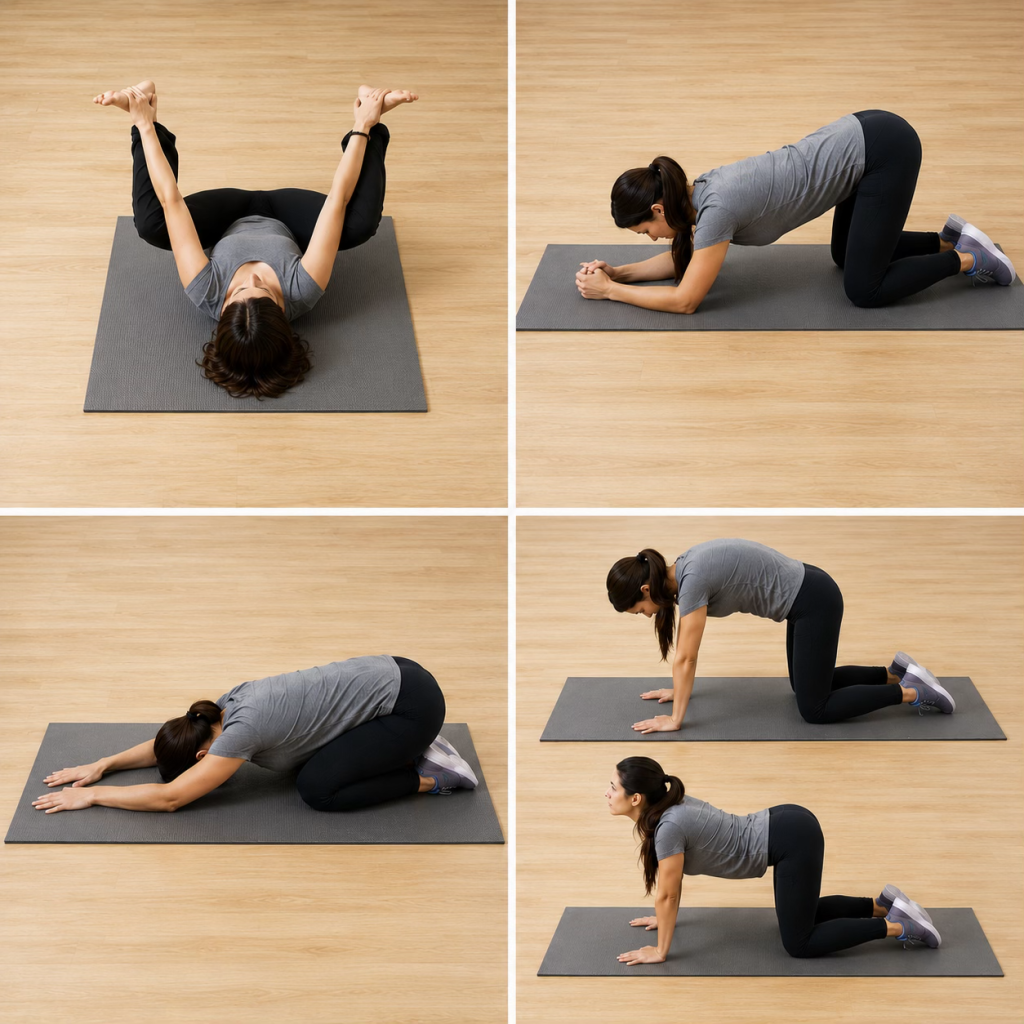
A few of the prescribed pelvic floor movements: happy baby pose, hip external rotator stretch, child’s pose, and cat-camel stretch. The poses are held for 2, 10, or 30 seconds for sets of 5 to 10, depending on the lift and movement.
She also corrected several form errors that had gradually crept into my lifting as I unconsciously worked around the issue in the past. Additionally, she implemented a feedback system where I reported the RPE (Rate of Perceived Exertion) of my working sets. This proved useful in identifying exertion levels that coincided with symptoms or feelings of urgency.
Over the following six months, I diligently reported all signs of urgency and every UI episode. Before long, we began identifying predictable patterns between poor movement quality and lifting-related leakage.
Currently, my program resembles a series of periodised blocks, with a “two steps forward, one step back” approach, adjusting weights and intensities according to the progress I made in rebuilding pelvic floor confidence. Most importantly, I was given the freedom to reduce training loads whenever symptoms were aggravated by factors outside my control, such as menstrual bloating, fatigue, illness, or even a sudden surge of anxiety.
Afterthoughts On My UI Recovery Journey
I am happy to report that while I still experience occasional UI, the episodes have become less severe, and the time between relapses continues to increase. This recovery process has also highlighted to me about how intricately vast an individual’s experience with urinary incontinence can be.
If you experience leakage during training, consider it information that requires action rather than a fate-altering verdict. I’d like to emphasise that while my treatment process worked for my particular circumstances, it may or may not be appropriate for yours. I would strongly recommend consulting a doctor or pelvic floor physiotherapist for a proper medical assessment to determine the most suitable course of action. From there, work through these concerns with a coach who understands how to modify your training while keeping strength as the main goal.
Recovery is possible with the right treatment approach, and working with the right professionals will help you stay on track to regaining lifting confidence. Most importantly, do not let embarrassment prevent you from having conversations that may feel uncomfortable. Chances are, you are far less alone than you think!
References
1. Physio & Sole Clinic Women & Children Centre. Urine Incontinence Treatment in Singapore: How to Regain Bladder Control Without Surgery [Internet]. Singapore: Women & Children Centre; 2025 [cited 2026 Jun 23]. Available from: Women & Children Centre article
2. Skaug KL, Engh ME, Frawley H, Bø K. Prevalence of Pelvic Floor Dysfunction, Bother, and Risk Factors and Knowledge of the Pelvic Floor Muscles in Norwegian Male and Female Powerlifters and Olympic Weightlifters. Journal of Strength and Conditioning Research. 2022;36(10):2800–2807. Available from: Journal of Strength and Conditioning Research paper
3. Fairbanks J, Couvillion K, Stierman J, et al. Stress Urinary Incontinence in Female Powerlifters. Medicine & Science in Sports & Exercise. 2018;50(5S):564. Available from: Medicine & Science in Sports & Exercise abstract
4. Hill A. “If You Wee Yourself, You Just Rock On”: Is Incontinence Inevitable for Women Who Lift Heavy? The Guardian [Internet]. 21 Jan 2025. Available from: The Guardian article
5. HealthXchange. Pelvic Floor Exercises for Urinary Incontinence. Singapore. Available from: HealthXchange