
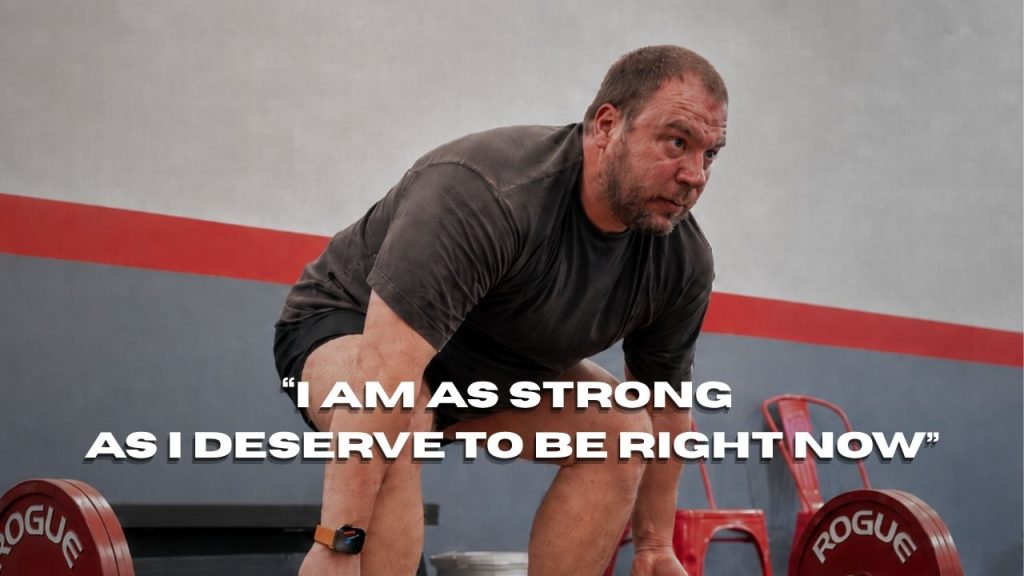
The awesome part of our job as coaches is that we also learn from our clients. This time, I got a good reminder, or maybe even life advice, from a client who has been training with us for seven years.
Unfortunately, his strength training has not been the smoothest in the past few years. It has been a few years since his PRs. However, beyond that, I’m glad to report that it’s been amazing to witness his family grow. He is now blessed with two kids, and with other work and life goals, there are things he needs to prioritize more than simply squatting and deadlifting as much as he can.
Recently, he has just recovered from a series of migraines and needs to visit a specialist; thus, when he’s back, he regressed yet again. I thought that he would be very frustrated with all these things, yet he commented:
“I am as strong as I deserve to be right now.”
While it sounds very simple, I find these words very meaningful.
When he said “deserve,” I do not think he meant it harshly. It was not about blaming himself or putting himself down. To me, it showed both contentment and self-understanding. On one side, he understood that his current strength was the result of his commitment and consistency in training. On the other hand, he understood that his recovery, stress, family, and other life priorities would also affect his results.
Being reminded of this, I think I could have addressed a few other clients’ queries, nagging, and frustration more effectively. I could also have made better sense of all the ups and downs of my own training over the past year and a half.
Truly, the answer is this:
“I am only as strong as I deserve to be right now.”
And in my case, why do I deserve to be in the position I am right now?
Reason 1: I miss some of my training, and I do not always give my best in training
While I want to PR my squat and deadlift again, I also have a lot of excuses.
I did my BJJ, which affected my recovery. I opened a new gym, which was stressful. Both contributed to weight loss. When the gym opened, I was on my own, and needed to get everything running with my own two hands. Ario came to help, but then the gym got busier! Now, I am having my second daughter.
Often, my day starts as early as 7 am and ends at 9 pm. Within my day, I really need to take a break because I do not have off days. It is my priority to coach fresh, so I need to take naps in the middle of the day. I do not want my tiredness to affect my mood or my coaching performance when I am client-facing.
I am not motivated enough to come to the gym at 5 am to do my own training, again because I need my sleep to operate. So what I do to adjust my training is to push it to slots where I have free time. Sometimes, I push it to another day so I can complete all my training within the week. However, there are weeks where I need to miss a few exercises.
With that, honestly, I understand that PR is going to be far.
If you miss training and you show up at less than your best, is it fair to expect the best results?
And I know that sometimes it’s not up to us; you got sick a few times, and training progress goes haywire. However, with all that sickness, is it fair to expect smooth sailing in training?
Reason 2: Priorities change, so effort changes
Life happens! And with that, priorities shift.
I see this a lot with our younger clients, especially once they get married and have their first child. Before we had children, I had more time to do my own workouts, and my wife also had more time to join other fitness classes.
However, once our first daughter was born, we had less “me time” and more chores, duties, and family time. As a dad, I can still get away with less than my wife. But as a mum, my wife needed to focus on the baby full-time for the next few months.
Now, imagine asking a new mother in that situation to focus on regaining her fitness and getting her old body back immediately. Other than probably making her angry, you would also understand that at that point in time, her baby is way more important.
That does not mean fitness will never be her priority again. It simply means that during that season of life, something else rightly takes priority.
In general, your priority will affect your effort, and your effort often reflects your results. Things might not be as direct as that all the time, but you can understand where I am coming from.
Setting aside periods where you are “lucky” or “unlucky,” the more you put your effort into things, the better the outcome tends to be. When I prioritize my training, my training seems to go better.
So, it is not always your fault that priorities change. But as we continue doing life, we may not always realize that the effort we put into training has shifted, intentionally or unintentionally.
With that, I also do not think it is fair to blame ourselves, or logical to be frustrated, that things are different right now.
However, life goes on, and we need to do what we need to do.
So the question is not whether we should give up. The question is: how do we train honestly within the situation we are currently in?
My advice consists of three steps.
Step 1: Identify and accept the limitations
I think it is a good idea to understand what we are dealing with and accept that it is going to be that way for the period of time that we expect it to be.
I suggest listing all the obstacles and excuses you face, as I did earlier. Also, be clear about what you want.
If you have seen the “College Triangle” of Sleep, Grades, and Social Life, you can only get two out of these three components. This is somewhat a version of that.
Putting more pressure on yourself where it is unreasonable is unreasonable. In general, getting all 3 components in the triangle is not possible, unless you are lucky, very smart, or somehow do not need any sleep.
Step 2: Create a structure
If you can point out the issue, maybe you can create a countermeasure where possible.
Unfortunately, making big changes when you are motivated to change often fails. Our motivation has a short lifespan before it goes stale. So when we create that “GRAND PLAN” to do stuff, it may work for a while before we get back to being too comfortable.
This is a common story for someone on a diet. Fast weight loss is followed by an equally fast rebound.
From the same guy who said this, who I consider the king of making structural changes, what he did to lose weight over the past year was two things:
1. No alcohol — no more explanation needed.
2. Every-other-day salad — changing his lunch to salad every other weekday.
Simple plan that works for him!
For training, the main variables to your “structure” are the frequency and duration of workouts.
I often have my clients move between 2 and 3 workout days per week, depending on work, or cut to 1 when it’s really tough.
Or if you can come to the gym less often but stay longer, no worries; lower frequency but a longer workout will serve you well.
Step 3: Show up!
Well, sometimes this is the problem in the first place. But a good plan you created in Step 2 should be one you can show up with at least 90% compliance. If it is less than that, it may be too drastic or ambitious for you right now.
Gain your momentum.
You will realize that, with good structure, once you start, it is easier to continue. And when momentum builds, it is more fun because you will get a sudden temporary novice effect where progress is visible.
However, when you are out of momentum, remember: build the next one!
Don’t Give Up!
Remember that you will be where you deserve to be. You might be training less than before because you have fewer resources at your disposal, but that does not mean that all your gains are gone.
Sometimes, we need to look back over a longer timeframe. Sometimes, you will realize that the lightweight you are doing right now was once a heavy weight that got you stuck.
Sometimes, it is more frustrating when it feels like we are back to zero. But I encourage you to keep at it at the level that you can manage at this time.
First, because even if training does not go well, you still get the overall health benefits of exercising.
Second, sometimes we do not know when the time and luck will be on our side. And for that, we need to get ready.
I once read a book by Chris Hadfield, the Canadian astronaut who became famous for singing “Rocket Man” on the ISS.
One line from him that stayed with me was:
“I never stopped getting ready. Just in case.”
That is how I see training too.
Maybe, with training, it is not exactly like practicing a song or a skill for a specific moment. But the accumulation of effort will get us ready for when our strength is needed, or when we can get back to taking better care of our strength and fitness.
PR might not be in sight, but your effort makes it more likely you’ll get it sooner!
So keep grinding.
And who knows? When the time is on your side, you can say:
“I deserved it.”