
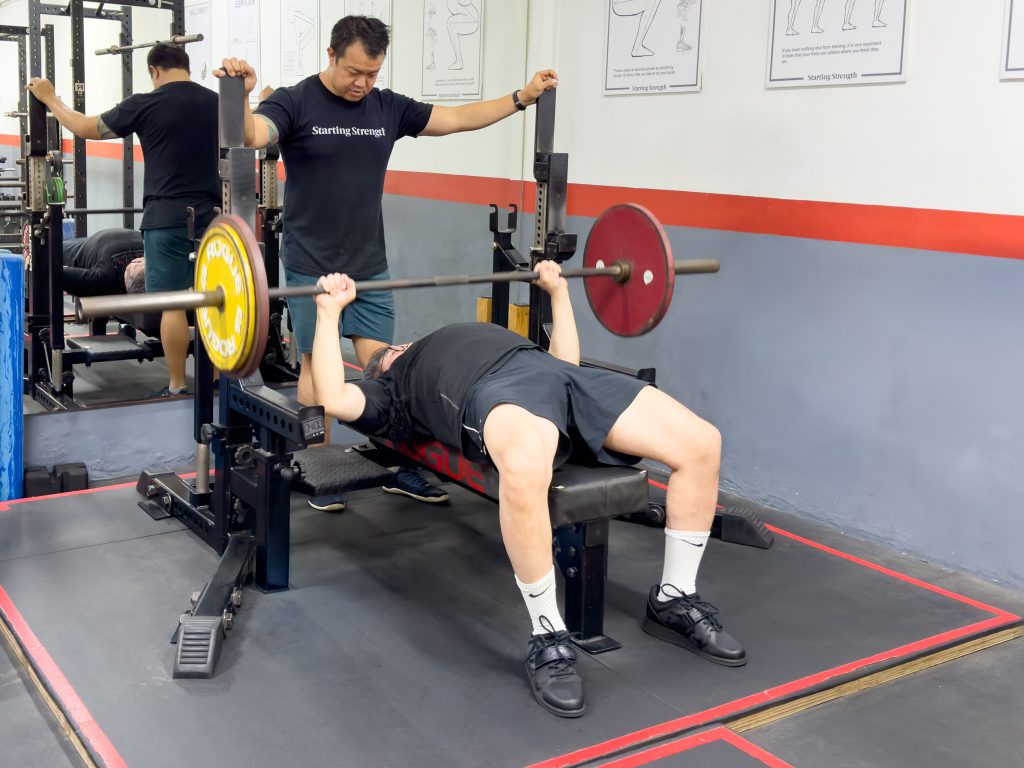
Some coaches actively cue their lifters to either tuck their elbows in or flare them out as they press the bar up on the bench press. I disagree with both approaches. On the bench press, the shoulder abduction angle, which is the angle the upper arm makes with the trunk, should stay the same throughout the entire rep, from the moment the bar starts its descent all the way back to lockout. Any drift in either direction is a technique error, which can create inefficiencies.
The arm can drift in one of two directions. Either by abducting, where the humerus/trunk angle becomes more open, which is commonly known as elbow flare, or by adducting, where it becomes more acute, which is commonly known as elbow tuck. In my experience, elbow flare is more commonly seen, but both can cause issues.
When the arm angle drifts, one of two scenarios follows. In the first scenario, the elbow maintains its vertical relationship with the barbell, staying directly under the bar even as the arm angle changes. In the second scenario, which is the worse of the two, the elbow drifts “forward” or “behind” of the barbell, and is no longer directly below it.
Checklist before you unrack the bar
Before you unrack the barbell when you bench press, you need to retract and depress your shoulder blades, pulling them down and back, to build as big an arch in your back as your flexibility allows. At the same time, drive your feet into the floor and transfer that leg drive horizontally along your body to push your upper back into the bench. This reinforces the arch and locks your upper back as a stable, rigid platform before the bar even leaves the J hooks.
Once your arch is set, your legs are driving, and you feel stable, you unrack the bar and bring it to the starting position directly above the shoulder joint. Take a big breath, hold it, and begin lowering the bar to your chest.
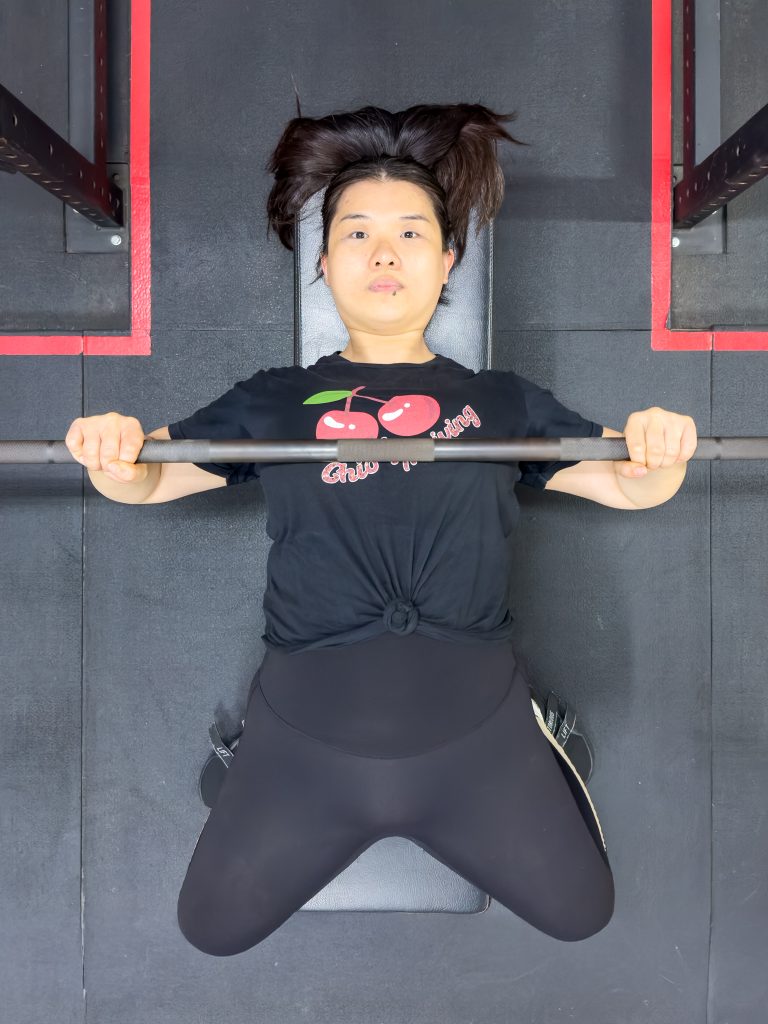
As the bar begins its descent, the angle between your trunk and your upper arm will be somewhere between 45 and 75 degrees. Where exactly depends on multiple variables such as your flexibility, which dictates how big of arch you can achieve, and whether you have any shoulder issues. Whatever angle you end up using that best suits your situation, maintain it throughout the entire rep.
As a side note, the most mechanically efficient angle is actually 90 degrees but we avoid that because it’ll cause shoulder impingement.
What problems a change in arm angle causes
Once you start pressing, if your arm angle drifts from that established angle, one or both problems will occur, whether the arm flares outward or tucks inward.
First problem, you will lose some of the concentric contribution from your pectoralis major, or pecs, momentarily, the prime mover on the bench press, towards pressing the bar back up to the lockout. The pec originates broadly across your clavicle, sternum, and the upper ribs and the fibres converge and insert near the top of the humerus, on the anterior side. Its main functions are shoulder horizontal adduction, shoulder adduction and shoulder internal rotation. On the bench press, the pec mainly contributes to the movement by its horizontal adduction function, which is pulling your upper arm across your body toward the midline.
As the bar descends and your arm holds its established angle, the pec contracts eccentrically, meaning it lengthens, reaching its longest position when the bar is at the chest. When you start to press the bar back up, the pec contributes to the movement by contracting concentrically, meaning it shortens, via horizontal adduction.
If your arm tucks as you press, several things happen at once. The pec shortens through horizontal adduction as it normally would, but the adducting arm adds a second shortening movement on top of that. At the same time, tucking the arm inward brings some external rotation on the shoulder joint, which partially lengthens the pecs. The combined shortening from horizontal adduction and adduction will be greater than the lengthening from external rotation, so the pec continues to shorten overall. The problem is that some of that shortening came through adduction rather than horizontal adduction, and adduction does not contribute to pressing the bar back up. And because the pec has now shortened more than it should have at that point in the rep, its ability to contribute to the press the bar up becomes less.
If your arm flares outward as you press, while the pec is shortening through horizontal adduction and internal rotation, the abducting arm simultaneously lengthens the pec. As this is happening, there will be a moment where the pec is in isometric contraction, and the muscle is neither shortening nor lengthening, which means that it’s not contributing to pressing the bar back up.
Second, if that arm drift causes your elbow joint to be “forward” or “behind” of the bar, you’ve created an unnecessary and inefficient moment arm between the bar and your elbow joint that shouldn’t exist. This can happen whether the arm flares out or tucks in. Now, in addition to the force needed to press the bar back up, you’ll need to produce more force to overcome this inefficiency, which makes the rep much harder than it needs to be. If the weight’s heavy enough, it’ll cause you to miss the rep.
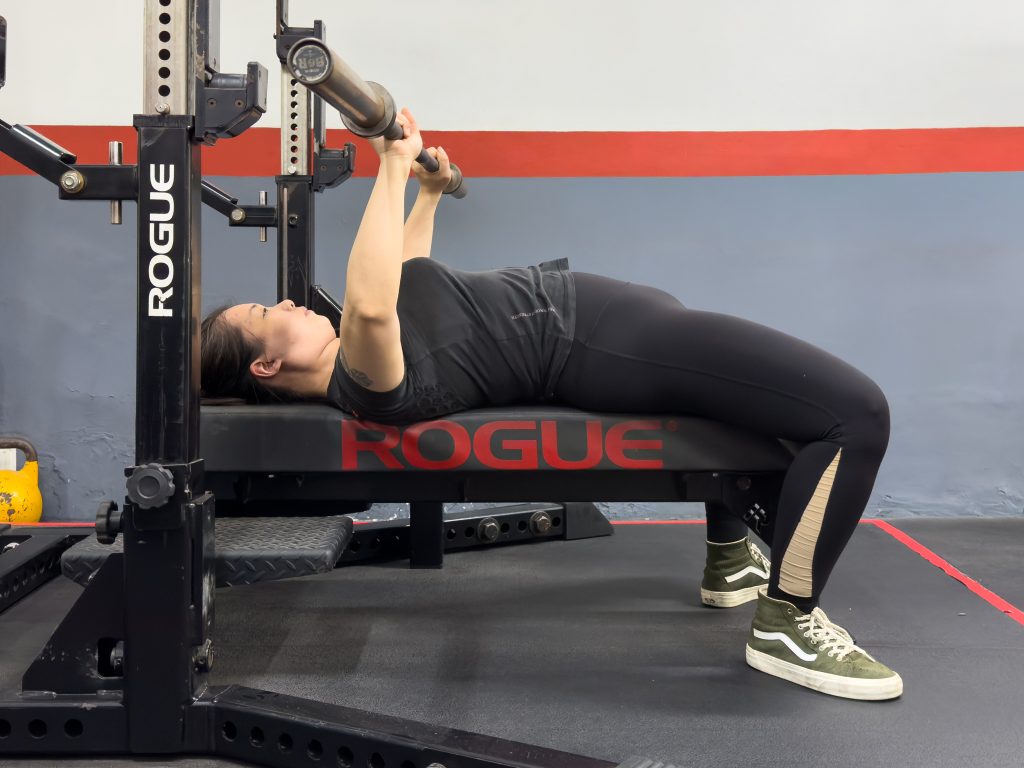
Elbows “forward” of the bar
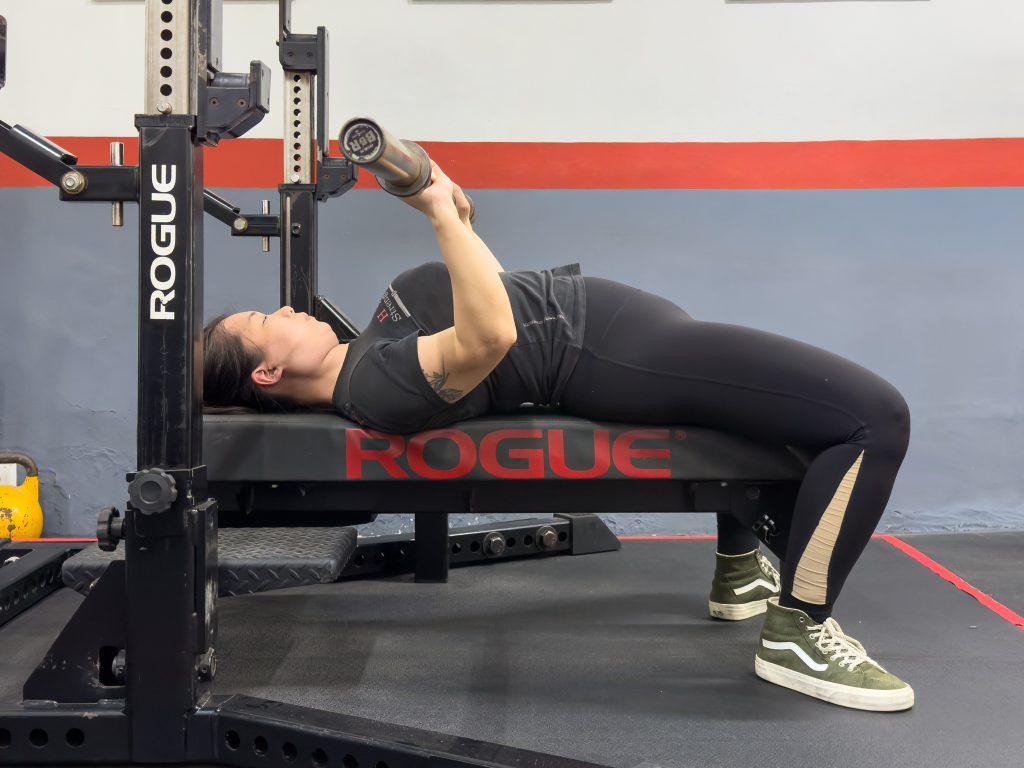
Elbows “behind” of the bar
Both of these inefficiencies will cost you weight on the bar. Here’s how to fix them.
Fix 1: Drive With Your Elbows, Not Your Hands
The simplest cue, and the one to try first, is a change in where you put your attention.
Instead of thinking about pushing the bar up with your hands, think about driving your elbows up and back diagonally toward your shoulder joint, and let your forearms and hands just go along for the ride. Your hands are the last link in the chain, and they’re a poor place to notice the arm angle drifting underneath them. Putting your attention on the elbow joint, the point where it dictates the humerus/trunk angle, fixes the issue where it starts. This cue addresses both the arm flaring outward and the arm tucking inward.
Fix 2: Get Your Lats Involved
One important note: this fix is specific to arms that flare outward. If your arms are tucking inward instead, using this fix will amplify the problem. For arms that have the tendency to tuck in as you’re pressing the bar up, Fix 1 is the right tool.
The latissimus dorsi, or lats, originate broadly from the lower half of your spine, the back of your pelvis and the lower few ribs and the fibres converge and insert near the top of the humerus, on the anterior side. Its main functions are shoulder adduction, shoulder extension and shoulder internal rotation.
Once the bar is unracked and the set is underway, the lats’ main job on the bench press is to hold that arch in place and resist any thoracic flexion throughout the set. Since shoulder adduction is one of the functions the lats perform, keeping them actively contracted throughout the rep gives you some resistance against your arm abducting as you press the bar up, helping you to maintain that humerus/trunk angle.
For some lifters, it can be hard to feel their lats contracting when benching. Here’s a drill to help you feel your lats contract when benching. You’ll need a training partner.
Set up on the bench as if you’re about to start a rep. Back arched, legs driving into the floor, elbows fully extended, hands positioned as though you’re holding the bar locked out directly above your shoulder joint. Have your partner stand at the head of the bench, take hold of both your wrists, and pull straight back toward themselves, as if trying to pull your arms past your head into shoulder flexion. As he’s doing that, resist that pull while keeping your elbows fully extended and your arch exactly how it was before they pulled. Done correctly, you should feel a contraction around the rear part of your armpit, close to your ribs.
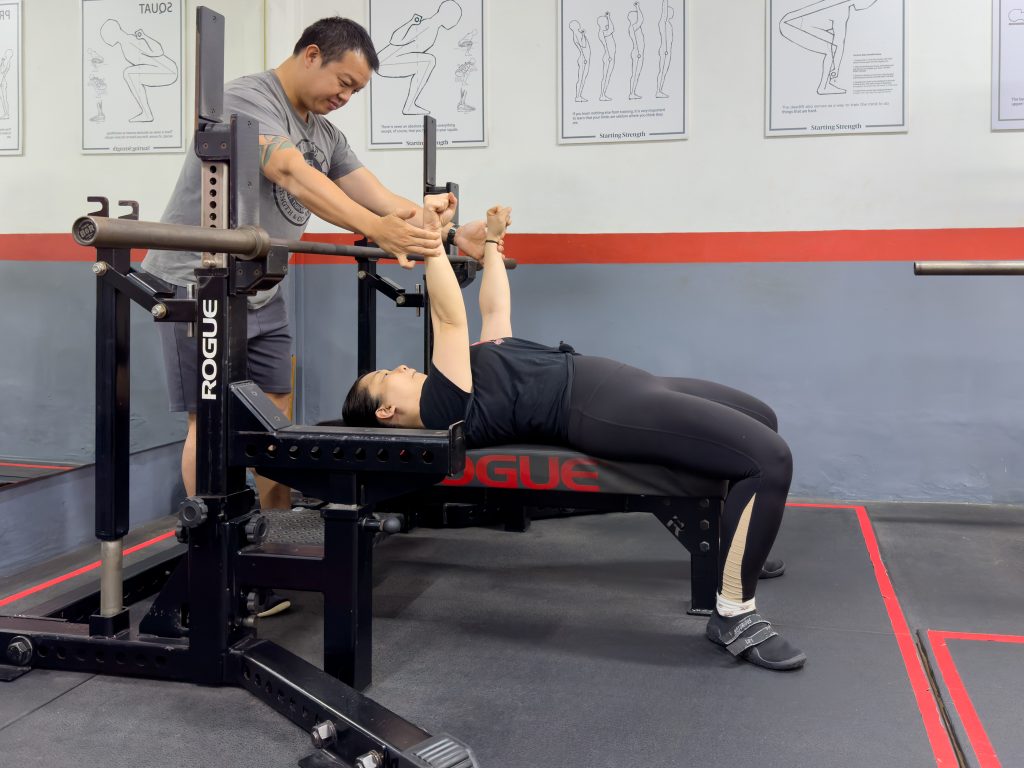
Once you know what that feels like, the goal is to hold that same contraction throughout your entire set, especially as you press the bar back up off your chest.
If that doesn’t work for you, try this cue instead. Instead of thinking about pushing the bar away from your body, think about it this way. When bringing the bar down to the chest, think about bringing the bar down and your chest up at the same time so that they meet in the middle. As you press the bar up, think about the chest rising together with the bar following it back up to lockout. Same outcome, different mental picture. Try both cues and see which works better for you.
If you have issues maintaining your humerus/trunk angle when you bench, try these fixes the next time you bench, but be sure to match the fix to the issue. If your arms are flaring out, both fixes can be applied. If they’re tucking in, only Fix 1 is your tool to rectify the issue. Either way, maintaining that humerus/trunk angle from the moment the bar starts its descent all the way back to lockout ensures that all of the concentric contraction of your pecs goes to pressing the bar back up via shoulder horizontal adduction.