
The squat grip is a funny thing! It is one of the first things we teach when someone gets under the bar, but once the squat actually starts, it often becomes one of the last things we care about.
When teaching newer coaches, my peers and I often use the grip as an example to illustrate coaching prioritisation.
“If someone is struggling with depth, and the grip is also wrong, fix the depth first.”
Now replace ‘depth’ with ‘balance’, ‘bar path’, ‘bottom position’, ‘back angle’, or ‘knee position’. In most cases, we would still put all of those above the grip.
And that is likely correct!
Coaching is about fixing the most important problem first. The most important problem is usually the one that affects efficiency, safety, or the lifter’s ability to perform the movement correctly. It is also about not overwhelming the lifter with too many corrections at once.
Getting a lifter to try to fix five things at the same time is usually fixing nothing. So the squat grip often gets pushed down the priority list.
Maybe with this, the immediate question will be:
“When does squat grip become high priority?”
However, if squat grip is often treated as low priority during coaching corrections, do we still understand what a good grip is supposed to do?
So, let’s see what we can learn to see how this “low-priority item” might actually be more important than people usually give it credit for.
What the Squat Grip Is Supposed to Do
The main job of the squat grip is to create a stable, rigid base for the bar.
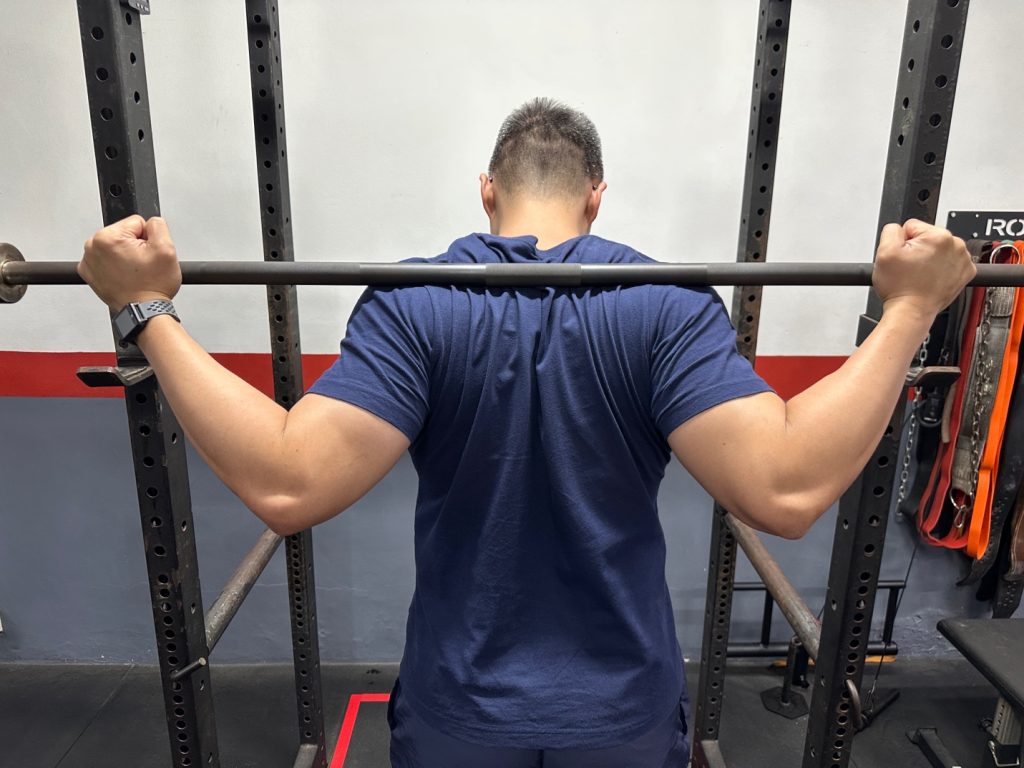
The bar should be supported by the torso and upper back. The skeletal system should transfer the load. The arms are there to pin the bar securely against the back, not to carry the vertical load of the bar.
In other words, your arms should not be “loaded” by the bar.
They are there to keep the bar in place.
When the grip does its job, it’s “impossible” for the bar to move much. The upper back feels tight. The squat form will stay consistent, and the movement will be predictable.
When the grip does not do its job, the first problem is usually not pain; it’s instability!
The bar may shift slightly during the setup, unrack, descent, or ascent. The lifter may feel like the bar is loose on the back. They may feel the need to hold the bar with their hands. They may struggle to get tight before the unrack. The squat may look slightly different from rep to rep because the bar is not fixed securely in place.
None of these are injuries.
But they are still problems!
A bad grip does not need to hurt before it matters.
Sometimes the early signs are simply that the bar feels loose, the arms feel tired, the lifter cannot get tight, or the squat feels inconsistent.
Pain is often the late signal.
Hand Position
We usually teach lifters to use a thumbless grip when squatting.
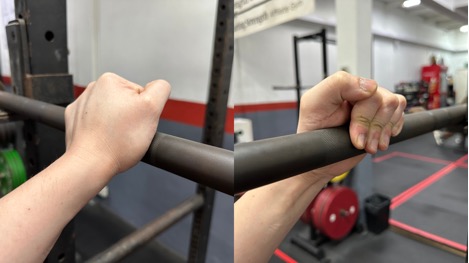
This means the thumbs stay on top of the bar instead of wrapping around it. The bar should sit on the meaty part of the hand, close to the base of the palm.
This matters because it keeps the bar closer to the wrist joint.
Think of the wrist as the pivot, and the barbell as the load. If the bar sits closer to the fingers, such as in a thumb-around grip, there is a greater distance between the wrist joint and the bar. That gives the bar more leverage to bend the wrist backward.
The farther the bar is from the wrist joint, the harder the wrist and forearm muscles have to work to stop the wrist from collapsing into extension.
You can feel this without a bar.
Hold one arm in front of you with your palm facing down. Extend your wrist and fingers. You will feel the forearm muscles tense immediately.
Now imagine that instead of doing it voluntarily, a heavy barbell is forcing the wrist into that position while you are squatting. Those repeated loads might one day become a problem.
When the wrist is bent back under the bar, the wrist flexors on the underside of the forearm may have to work isometrically to resist further wrist extension. Many of the superficial wrist and finger flexors, along with the pronator teres, share a common attachment near the medial epicondyle, the bony part on the inside of the elbow. This is the same general area involved in medial epicondylitis, commonly known as golfer’s elbow.
This does not mean every case of elbow pain in the squat comes from the grip.
But if a lifter repeatedly squats with the bar forcing the wrists into extension, the grip can contribute to irritation around the wrist, forearm, or elbow.
So when a lifter says their forearms, wrists, or elbows feel tired after squatting, pay attention.
The arms should not feel like they are doing a major part of the work.
Grip Width
Grip width also matters.
We want the upper back to help support the bar. This happens when the scapulae are retracted, bunching the upper back muscles together to create a more secure platform.
In general, a narrower grip helps create a tighter upper back.
But “narrower” does not mean “as narrow as possible no matter what.”
The ideal grip width depends on the lifter’s body size, shoulder flexibility, and tolerance around the wrists and elbows. The goal is to use the narrowest grip the lifter can comfortably tolerate while keeping the bar secure and the joints happy.
If the lifter gets under the bar with a thumbless grip and the wrists immediately bend backward, that may be a sign that the grip is too narrow for now. Widen the grip slightly and see if the wrists can stay more neutral.
On the other hand, if the hands are so far above the bar that the wrists flex in the opposite direction, the grip may be too wide.
The goal is not to win a narrow-grip competition.
The goal is to find the grip that allows the upper back to stay tight, the bar to stay secure, and the wrists, elbows, and shoulders to tolerate the position.
Forearm Angle
A lot of lifters think of the bar like a ball sitting on a slope.
The slope is your back. Gravity wants the ball to roll down. So naturally, the lifter tries to stop it by using the arms. They crank the elbows up, jam the bar hard into the back, and try to hold everything in place.
The problem is that the arms will now have to do a lot of work in stabilizing the bar.
Ideally, the shelf for the bar should come mainly from the upper back, not from the arms. When the scapulae are retracted, the area between the traps and posterior delts bunches up and gives the bar a place to sit. The arms help secure the bar into that shelf, but they should not be the thing creating the shelf.
This is why the forearm angle matters.
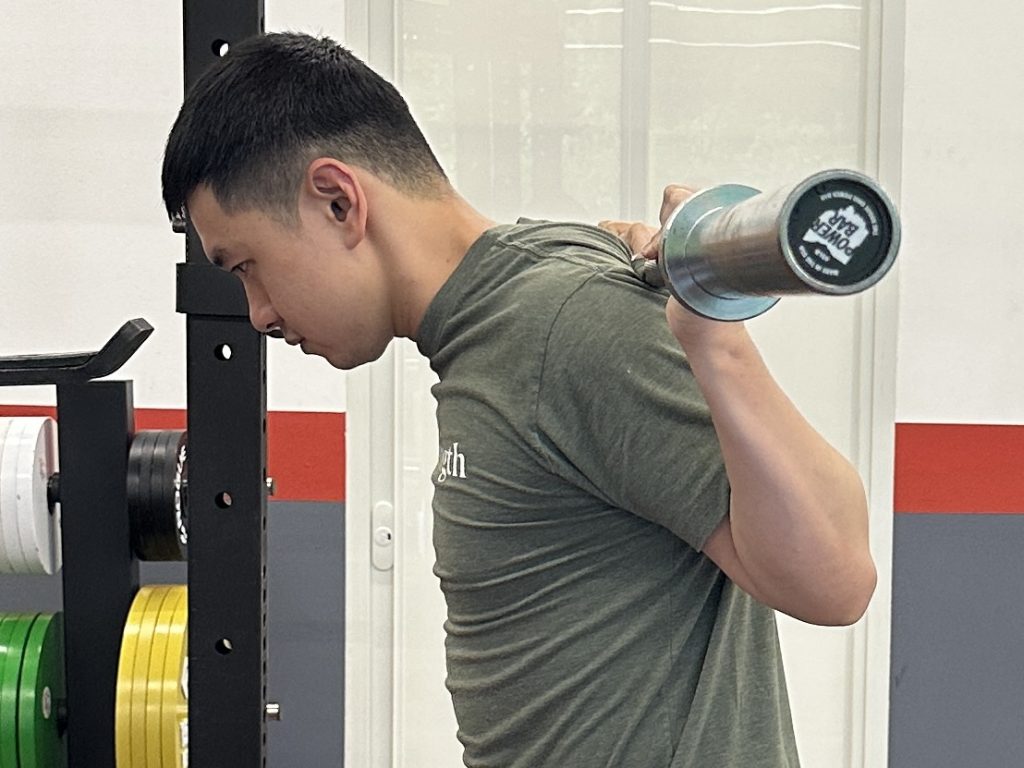
With a good grip, a reasonably narrow hand position, retracted scapulae, and neutral wrists, the forearms will usually sit roughly PARALLEL to the torso. In that position, the arms can help keep the bar in place without feeling like they are holding the bar up.
Now let’s discuss the opposite scenario. When the wrists bend backward, the elbows often drop more underneath the bar. The forearm will be too vertical. Since gravity is still pulling the bar down, the lifter can now feel more of that load through the wrists, elbows, and arms. Instead of simply pinning the bar into the back, the arms start helping to support it.
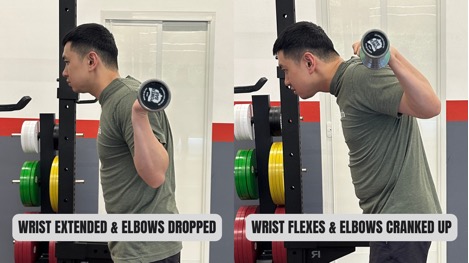
A grip that is too wide can create another version of the same problem. Because the upper back shelf is not tight enough, the lifter may compensate by lifting the elbows hard to jam the bar into place, as discussed above. Again, the arms end up doing too much work.
So, as a good marker: forearm parallel to the torso!
Deviating From the Ideal
The thumbless grip is the standard.
From there, every modification gives the lifter more freedom to reach the bar, usually at the cost of tightness, stability, or joint comfort.
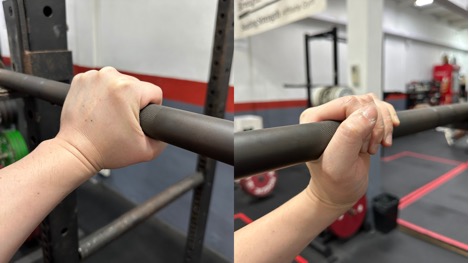
The first modification is the thumb-around grip. In this grip, the four fingers remain over the bar, but the thumb wraps around it. This may feel more natural to many lifters, and in some cases, is useful.
The trade-off is that wrapping the thumb around the bar often moves the bar slightly farther from the wrist joint and allows more wrist extension.
That extra movement can help a lifter with limited shoulder mobility because it gives the arm more freedom to find a workable position under the bar. But it usually comes with a cost: the position may be less tight, and the wrists and elbows may experience more stress.
The next step down is what we call the Talon Grip.
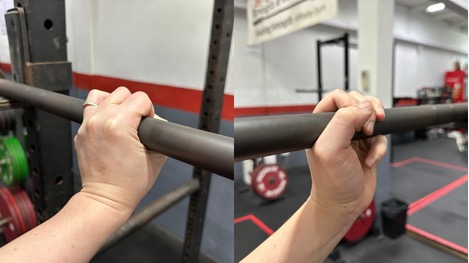
In this version, only three fingers remain over the top of the bar. This gives the lifter even more flexibility, not only because it passes the wrist, but also through the joints at the base of the fingers or the metacarpophalangeal joints.
This can be useful for lifters with limited shoulder flexibility, especially when widening the thumbless grip is not enough, or when the lifter is already reaching close to the collars, rack hooks, or edge of the bar.
But the trade-off is clear.
Fewer fingers over the bar usually means a looser, less stable bar position. It may also increase stress on the wrists, elbows, or hands because the bar is no longer supported as efficiently.
For lifters with very restricted shoulders, another option is to use lifting straps as handles. Instead of gripping the bar directly, the lifter holds the straps attached to the bar.
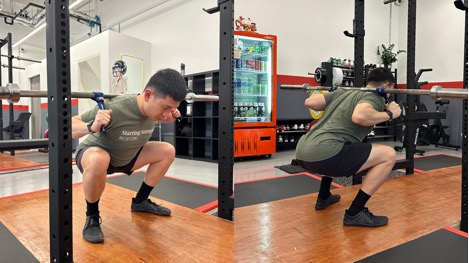
This can allow someone with very limited shoulder mobility to squat when they otherwise could not get their hands into position.
A similar option is the safety squat bar. In a way, it solves the same problem as using straps on a normal bar, because the lifter no longer needs to reach back and grip the bar in the usual squat position. The advantage is that the safety squat bar is usually more stable than holding straps on a straight bar. The downside is that most gyms do not have one, and many safety squat bars are quite heavy, which may be an issue for some lifters.
For a lighter workaround, Shaun has also made a video showing how to build a PVC safety squat bar setup.
That being said, I usually treat these as temporary workarounds. Many clients only need a few sessions or a few weeks before they can progress from straps, a safety squat bar, or a Talon Grip to a thumb-around grip, and eventually a proper thumbless grip.
In more severe cases, such as a lifter with shoulder replacements, one of these modifications may remain necessary long-term.
The important point is this: these modifications exist because the lifter currently cannot achieve the ideal position.
We are making a compromise so the person can still squat.
And in many cases, that is the higher priority.
When Grip Moves Up the Priority List
So if the squat grip is often low priority, when does it become important enough to address directly?
First, when the bar is unstable.
If the lifter cannot keep the bar secure on the back, grip is no longer a small technical issue. It becomes one of the main problems to solve.
If a lifter needs straps as handles and the position is still unstable, the goal should be to gradually move them toward a more secure grip. This may mean progressing to a Talon Grip, then a thumb-around grip, and eventually a thumbless grip if their mobility allows it.
We can work on this with lighter weights than their working sets. Get them into position, let them hold it briefly, and gradually increase their tolerance over time.
Second, grip moves up the list when pain appears.
Grip-related issues involving the wrists, elbows, or shoulders can take a long time to settle once they become painful. If a lifter reports discomfort that seems connected to the grip, deal with it early.
Third, and this is the most practical point, grip can usually be adjusted before the set starts.
This makes it different from many other squat corrections.
Depth, balance, knee position, bar path, and back angle often need to be corrected while the lifter is moving. Grip, however, can usually be checked during the setup, before the unrack.
So, unless the lifter is already overwhelmed, there is often little downside to checking the grip before the set.
A small correction before the unrack may improve bar security, reduce arm tension, and make the rest of the squat easier to coach.
TLDR
So, when does squat grip become high priority?
When it starts affecting the squat.
If the bar is moving around on the back, if the arms are getting tired, or if the wrists, elbows, or shoulders start to complain, then grip is no longer just a small detail. It has become something that needs to be addressed.
But until then, it may not be the first thing we fix.
If the lifter is missing depth, losing balance, or sending the bar all over the place, those problems probably matter more. That is just coaching prioritization.
But low priority does not mean we ignore it.
A good grip has a job. It keeps the bar secure against the upper back, reduces unnecessary work from the arms, and helps the lifter feel stable before the set starts.
Thankfully, the grip can usually be adjusted before the lifter even unracks the bar. It does not need to take attention away from the set. If a quick adjustment during the setup can make the bar feel more secure, reduce arm tension, or prevent a small issue from becoming a bigger one, then it is worth doing.
Sometimes we leave the grip alone because something else matters more. Sometimes we accept a temporary workaround because the lifter still needs to squat.
But we should not let “low priority” quietly become “no priority.”