
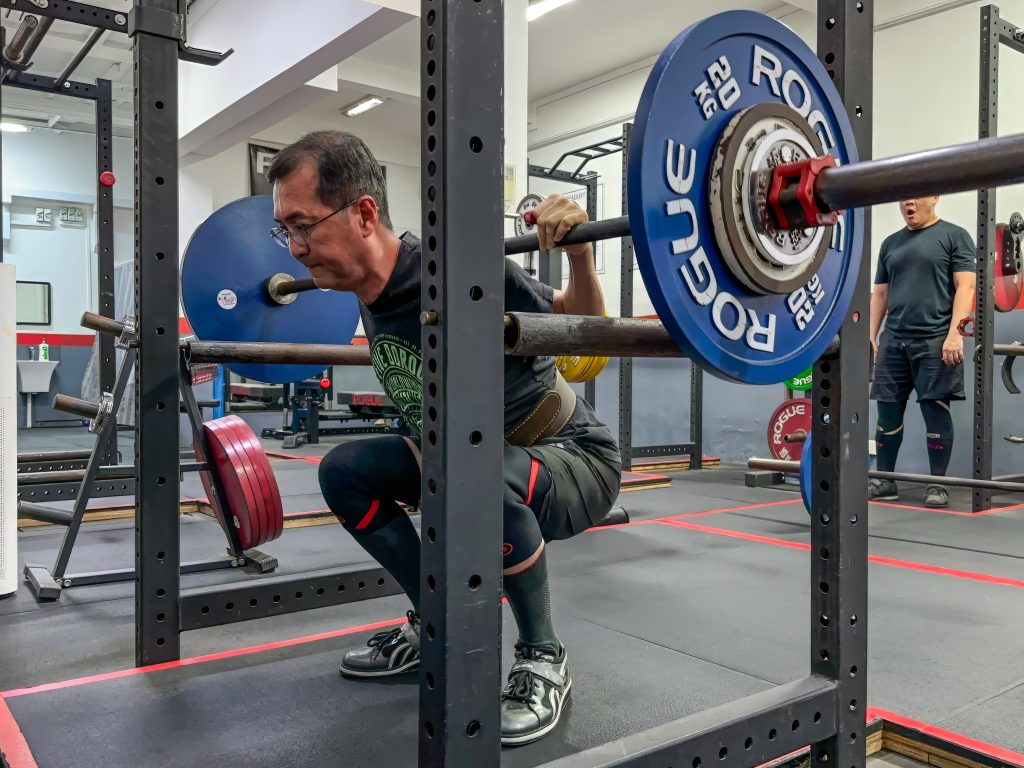
When we coach the squat, we advocate the low bar squat, which uses a more horizontal back angle and that allows us to access the big strong muscles of the hips. This enables us to squat heavier weights, which in turn makes us stronger. The physics and anatomy of the low bar squat mechanics have been written about extensively in the book Starting Strength: Basic Barbell Training, 3rd edition and many articles, so I won’t delve into that here.
The low bar squat requires you to a more horizontal back angle, achieved by leaning over and reaching your hips back. How horizontal your back angle should be differs from lifter to lifter, depending on your anthropometry. A lifter with a long trunk and short limbs will be more vertical as compared to a lifter with a short trunk and long limbs (read more about it here). When you squat, you want your back angle to be as horizontal as possible while still maintaining balance throughout the whole range of motion and being able to squat to depth consistently.
The bar is always over the mid-foot
Before you begin the descent, the bar should be positioned directly over the middle of your foot, which is your center of balance, and it’s an excellent idea to maintain that relationship throughout the entire set. If the bar shifts either forward or backward relative to your mid-foot, it will introduce an unnecessary moment arm which you will need to overcome; failing which, you will lose balance if the weights are heavy enough.
Initiating the descent: three movements happen together
When we initiate the descent in the squat, three things happen concurrently: your hips flex, and your knees both flex and go wide to match your feet angle (to be parallel to where your feet are pointing, which is about 30 degrees out).
All three have to occur simultaneously – not doing so will cause issue. If your knees flex first before your hips, some of the weight will shift forward towards your toes. If you flex your hips and shove your butt back first before flexing your knees, your knees will get to their position at the bottom of the squat instead of one-third of the way down like they should, causing what we call “knee slide”, which can sometimes irritate sensitive knees. Lastly, if you flex your hips and knees and lean over but not shove your hips back sufficiently, the bar will shift anterior to mid-foot.
Your knee position, hip position and back angle will move into their rightful places by about one-third of the way down. Think about getting there smoothly and gradually instead of trying to get them there immediately the moment you start to descend.
Common descent errors and corrections
The most common issue new lifters have when learning how to squat is getting the correct back angle. Some lifters squat with their trunk more vertical than they should (more common), whilst others are too horizontal (far less common). Apart from getting the correct back angle, these are the common errors I’ve observed from lifters while descending on the squat.
Error 1: The lifter flexes their hips too much without sufficient knee flexion
I’ve observed that this usually occurs with lifters who aren’t very strong. My hypothesis is that they’re hesitant to flex their knees more to descend because of the fear that they might not be able to get back up. So they go “deeper” by flexing at the hips, instead of the hips and the knees. The bar gets lowered, but not so much at the hips and always results in a squat that is not to depth. To fix this, think about “bending the knees more”, “let your knees travel forward more” or “bring your butt closer to the floor”.
Error 2: The lifter leans over without shoving their hips back enough
When I’ve coached lifters who tend to do this, I let them know that the issue is occurring and that they need to reach their hips back or sit back more as they descend. While some lifters aren’t aware this is happening, others are, and the reason they give for hesitating to pull their hips back more is that they worry they’ll fall backwards if they reach their hips further back. I then explain that as long as the bar stays over mid-foot, they will remain balanced. And in the unlikely event that they do happen to lose balance backwards, the safeties are there to catch the bar.
Funny enough, I’ve had three lifters lose balance and fall forward because they were too worried about falling backwards and overcompensated. So far, no lifters have fallen backwards, and I’m confident it will stay that way.
Holding the positions throughout the descent
Back angle, knee and hip position aren’t something you can just set and forget. Holding the hips back and maintaining your back angle requires constant attention throughout the descent.
A commonly used cue to get lifters to shove their hips back more is to tell them to reach their butt back to the wall behind them and point their chest to the floor. While that can work to get the lifter to reach their hips back more at the start, if the lifter isn’t constantly thinking about holding the hips back as they go down, it’s likely that it won’t stay there. The hips will tend to shift forward as the lifter approaches the bottom, causing the lifter to either shift forward or their back angle gets more vertical. Getting the hips back at the start is one thing; keeping them there as you descend to depth is another.
Here’s another way to think about it. We’re going to use the same “reaching the butt back to the wall behind you” cue but add that after your butt contacts the imaginary wall behind you, slide it down the wall without breaking contact or pushing harder into it – the contact pressure between your butt and the wall should be consistent throughout. This gives you something to focus on whilst descending instead of only achieving something at the start.
When done correctly, the butt remains in contact with that imaginary wall and your hips maintains its degree of rear displacement throughout the entire descent.
The ascent: hip drive without displacement
Now you’re at the bottom of the squat. You’re going to call on the biggest and strongest muscles in your body to stand back up, and you do this by using hip drive. This is done by driving the hips up in the same plane that they went down. Remember sliding your butt down the imaginary wall behind you? The same thinking can be applied to the ascent of the squat as well. This time, while keeping your chest pointing down, think about driving your hips up to the ceiling while maintaining the contact between your butt and the imaginary wall. As with the descent, the contact pressure between your butt and the wall should be consistent as you drive your hips up.
This can help solve issues like lifting the chest too early, which kills the hip drive.
Putting together the complete movement pattern
Throughout the squat, the bar stays directly over mid-foot. On the way down and up: get your butt back to an imaginary wall behind you and lean over. Slide your butt down and up the imaginary wall without breaking contact or increasing contact pressure. This will get you in a good position to be as leant over as possible while staying in balance and consistently achieving depth, so that you can squat the most weight possible.