
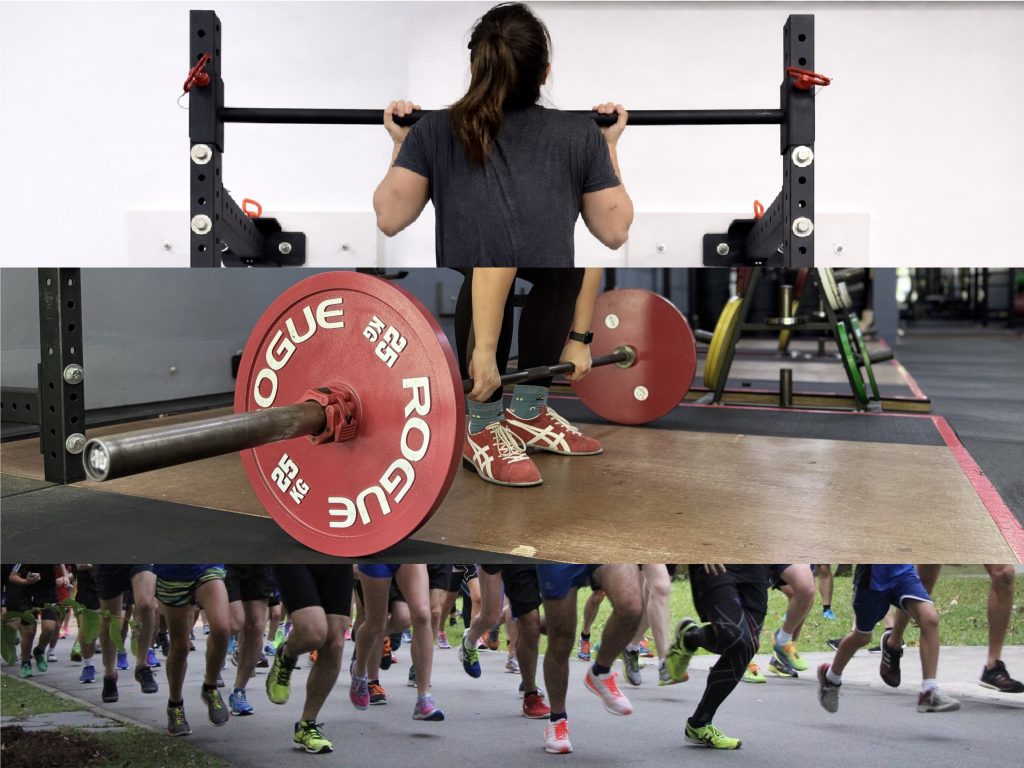
Whenever a new client joins us at Hygieia, we always ask about their training history. Quite often, they either begin from a largely sedentary lifestyle, or arrive with some form of “regular exercise” or “staying active” already in place — all of which share little similarity with the training we do.
So what exactly do these people mean by “exercise” and “staying active”?
For many, exercise refers to a broad, catch-all term that includes most forms of physical activity – running, swimming, long walks, yoga, high-repetition and low-weight workouts, machine-based routines, or HIIT and circuit training. Interestingly, training with a barbell is often excluded from this definition, perhaps because it appears too technical, too heavy, or reserved for athletes rather than the general population. As a result, most people gravitate toward forms of exercise that is easily accessible and familiar, and which align with a baseline idea and image of what it means to be “fit”.
It doesn’t matter if people assume training with barbells to be an exclusive type of exercise reserved for the physically elite, or if they felt that they are somehow not suitable for such a complicated activity, training for strength is visibly gaining in popularity globally as more are getting educated about preventing age-related issues. People are finding ways to get stronger, but not all are connecting the dots and heading for the barbell rack directly, often times starting with more “exercising”, and running its course until it proves to be inefficient at getting them stronger.
This common perception of exercise, I would argue, has probably been influenced by institutional standards and widely accepted guidelines.
Physical tests and Singapore physical activity guidelines
Let’s take a look within the local context in Singapore. There are two well-known fitness tests that most Singaporeans are familiar with: National Physical Fitness Award (NAPFA) for primary and secondary school students, and Individual Physical Proficiency Test (IPPT) for National Servicemen and regulars.
NAPFA evaluates a student’s overall physical fitness levels, using six stations: bent-knee sit-ups, standing broad jumps, sit and reach, inclined pull ups or pull ups, 4x10m shuttle runs, and a 2.4km run. [1]
IPPT is also a compulsory test for testing the basic components of physical fitness and motor skills of anyone with National Service (NS) liability including NSmen, reservists, and regulars. At present, there are only three stations: sit ups, push ups, and a 2.4km run. Prior to 2015, the test had five stations that were derived from the NAPFA test: sit up, standing broad jumps, chin-ups, 4x10m shuttle runs and the 2.4km run [2]. Cash incentives of $200 to $500 are awarded based on performance. [3]
Being used as the standard test for evaluating physical aptitude, these exercise stations over time have come to represent a widely accepted benchmark for physical fitness. For many young Singaporeans, this becomes their earliest and most influential exposure to structured exercise, shaping their understanding of what it means to be physically capable way before they ever step into a gym.
Then, we have the 2022 Singapore Physical Activity Guidelines, which was set by Sport SG and Health Promotion Board (HPB) [4]. The main focus is largely based on the World Health Organisation’s definition of physical activity, which is “any bodily movement produced by skeletal muscles that requires energy expenditure”, and therefore “recommends both moderate- and vigorous-intensity physical activity for an improved health.” 150-300 minutes of moderate-intensity aerobic physical activity and muscle-strengthening activities at moderate or greater intensity at least two days a week is recommended, which is a newly added revision from the 2011 guideline. [5]
Through the guide, the terms “weight training” and “muscle/bone strength” are mentioned at least once per subpopulation (school children, youth, adults, older adults etc). The suggested activities that fall under “vigorous intensity muscle/ bone strengthening” vary across a wide range, and to quote a few:
For school children – games at the playground, circuit training, football, martial arts, dancing
For adults (18-64 years old) – tai chi, pilates, and weight training
For older adults (65 years and above) – tai chi, pilates, and weight training
With the guideline equating weight training to taichi and pilates, it is no wonder that anyone following the recommendations will have an equally misinformed perception of the activities that stimulate muscle growth. Other than weight training, all other suggested activities for “muscle/bone strengthening” don’t provide nearly enough load-bearing resistance over time, as the exercise runs its course of applying stress progressively to cause muscle growth, and therefore “strengthening”. To get stronger, you need to lift heavier weights progressively over time. Tai chi and pilates can’t do that.
Some suggestions for changing perspectives around strength
More people are seeing strength as a valuable trait that allows physical independence and higher quality of life, but this increase of awareness largely comes from individual research. Are there ways that knowledge around the importance of strength could be embedded earlier, perhaps in schools or as mandatory requirements?
If the national guidelines are trying to emphasise on muscle strengthening, and if policymakers and professional practitioners are using the guidelines as reference material, there are two areas which, I think, can impact the population to accept getting strong as a necessity.
Firstly, make strength a requirement for the qualifying physical tests, starting from NAPFA, and then the IPPT. The exercise stations and requirements could potentially look like this:
Strength Display Requirement, 3 single reps per event:
• Overhead Press
• Deadlift
• Maximum chin-ups in 1 minute
• 2.4km run
In this hypothetical revised physical test, I have chosen press and deadlift out of the four barbell movements, the squat could encounter with technique and onsistency issues regarding depth, and the bench could meet with safety issues when performed across a large cohort. Press and deadlift are easier lifts to set up and learn. Three single rep attempts are required for every lift.
And because everyone (especially Singaporeans) love a good points-and-reward system, this could be the revised award and incentive system for the strength stations:
| Overhead Press or Deadlift | NAPFA | IPPT | IPPT incentive |
| Breaking individual heaviest recorded (minimum 0.5kg) | Grade A | Grade A | $300 per Grade A |
| At least 1 rep within 90% of individual heaviest recorded | Grade B | Grade B | $100 per Grade B |
| All reps within 75% against heaviest recorded | Pass | Pass | No incentive |
To enforce such a test could possibly encourage entire generations to maintain their ability to continue performing close to or better than their previous bests. What could be better than being awarded cash for displaying strength? Not only would the test require an average person to stay familiar with the process of staying strong, the preparation alone will force them to make way for better health choices to optimise their chances at earning the incentives.
Secondly, to edit the guidelines with an emphasis on how strength influences one’s ability to be physically active. With NAPFA and IPPT making the display of strength one of the main incentives, the population could be more receptive to understanding strength as a requirement. Detailed discussions across the guidelines should aim at improving the general population’s understanding of strength with topics such as:
• Importance of muscular strength as the backbone of all physical activity
• How muscle mass adapts to external resistance
• Understanding the differences of exercise modalities and training effects that can be achieved (for example, Taichi improves mobility, running improves endurance, neither improves strength)
• How physical activities directly benefit from getting stronger
• Importance of osteoporosis prevention and management at all ages by growing denser bones through progressive loading over time, not through any random rigorous physical activity
While I understand that current guidelines and policies are written for the population at large in mind, especially with older generations and mindsets taken into consideration, the current written language can sound dismal — recommending “some activity better than none”. But, I believe, that if the guidelines clearly state and advocate for the direct connection between strength and its ability to improve quality of life, the general population can slowly accept and steer towards choosing strength training as a main modality of exercise.
Hope for a physically stronger population
Perhaps I might sound overly wishful, but I don’t think my suggestions sound too ridiculous. With Singapore’s ageing population, the ability to remain strong will be the most valuable feature that enables physical freedom as one gets older. While it’s never too late to start, good habits formed among the youth as a result of a requirement can very well be a cultural impact that forms a baseline of strength across generations to come.
If a population is institutionally encouraged and incentivised to stay strong as a requirement, we’d probably see fewer wheelchairs and walking sticks.
References:
1. Singapore Sports Council. National Physical Fitness Award (NAPFA) Standards. Retrieved from NAPFA Standards PDF
2. Singapore Armed Forces / Ministry of Defence. IPPT and NS Fit Overview. Retrieved from IPPT and NS Fit
3. Singapore National Service Portal. IPPT Stations and Scoring System. Retrieved from: IPPT Stations and Scoring System
4. Health Promotion Board. Singapore Physical Activity Guidelines (2022). Retrieved from Singapore Physical Activity Guidelines
5. Health Promotion Board. Run from Chronic Illnesses – Exercise and Fitness. Retrieved from Run from Chronic Illnesses