

Every once in a while, a client asks: “How many calories do I burn during a lifting session?”
That question, combined with a conversation with another lifter, led me to an interesting thought: could we actually calculate this using simple physics?
From basic physics, work is defined as:
Work = Force × Distance
In the context of lifting, this becomes:
Work = mass × gravity × range of motion
So, if I multiply the weight on the bar (in kilograms), gravity (9.81 m/s²), and the vertical distance the bar travels, I should get the total work done in joules. From there, I can convert it into kilocalories (kcal), the same unit we see on food labels. For reference, a 320 ml can of Coca-Cola Original Taste Less Sugar in Singapore contains 61 kcal. If this works, we should be able to estimate how much of a soft drink a lifting session is actually worth.
The experiment
To test this, I ran a small experiment during my overhead press session. My planned workout was 60 kg for 5 sets of 5 reps, but I also included my warm-up sets, since they represent real work done:
20 kg × 5 reps
40 kg × 5 reps
55 kg × 2 reps
60 kg × 5 reps × 5 sets

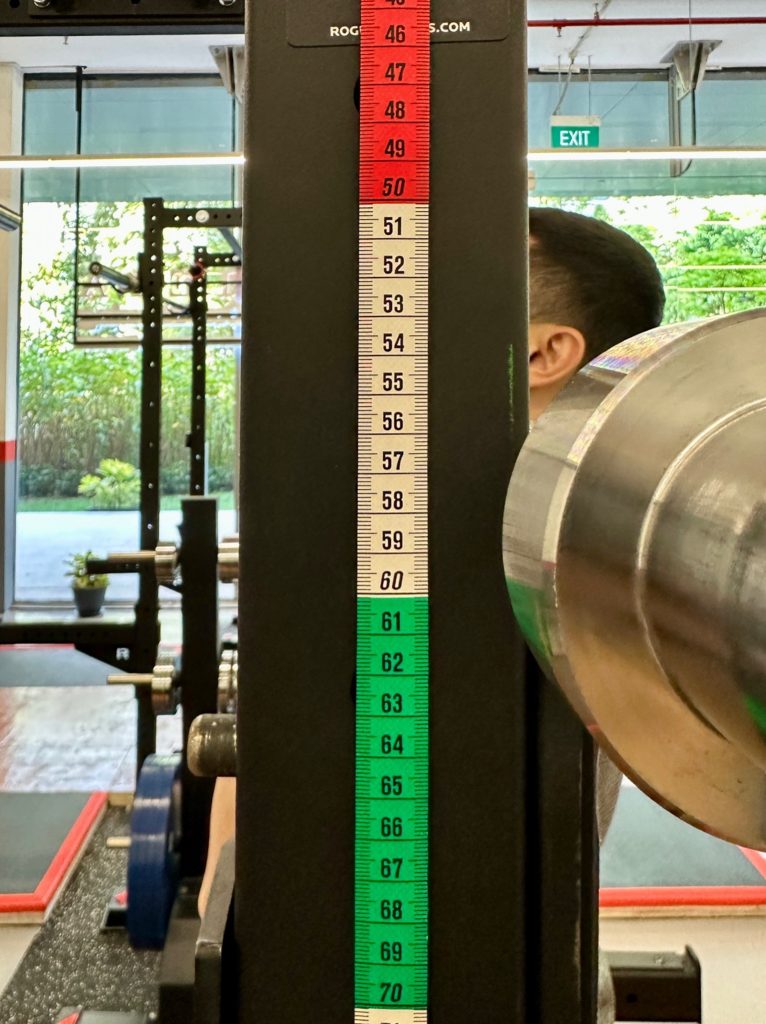

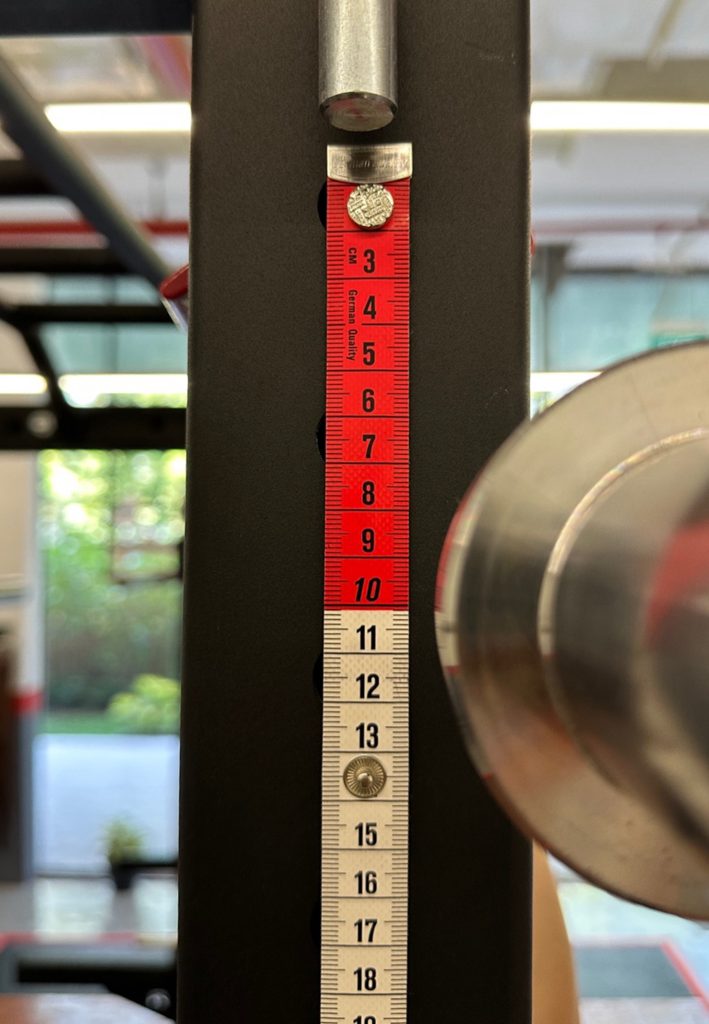
Measuring ROM using measuring tape
I measured the range of motion on the rack with a tape measure and found it to be 48 cm (0.48 m). Note that this calculation captures only the concentric phase when the bar is moving upward. The eccentric phase, lowering the bar under control, also costs metabolic energy, even though it does not add to the external mechanical work calculated here. With that caveat in mind, I simplified the process by multiplying total tonnage by gravity and distance rather than calculating each rep individually.
The result
8.98 kJ, or about 2.12 kcal.
That’s roughly equivalent to 11 ml of Coke! Barely a sip! Less than a tablespoon of Coke!
Comparing It with the Apple watch
Curious about how this compares in practice, I also recorded the session using my Apple Watch. To keep things “more accurate”, I stayed near the rack, rested on the nearest bench between sets, and limited unnecessary movement. The session lasted just over 30 minutes, including setup and clearing up of the weights after the workout.
The result? 173 kcal of active energy expenditure – about 82 times higher than my physics-based calculation.
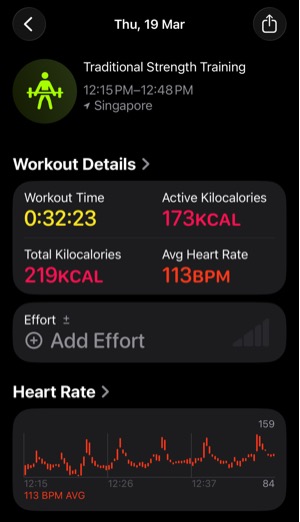
Workout recorded in Apple Watch
So what’s going on?
Two completely different measurements
Comparing the physics number to the Apple Watch number is, ironically, not an apples-to-apples comparison.
The physics calculation only accounts for mechanical work – the energy required to move the barbell from point A to point B, and only the upward portion at that. It is a clean, narrow measurement of one specific thing. The Apple Watch, on the other hand, estimates physiological energy expenditure across the entire session: bracing, stabilising, co-contraction of muscles, controlling the eccentric phase, elevated heart rate, breathing, and baseline metabolic activity during rest periods, setup, and cleanup. It is measuring something far broader – not just the lift, but everything your body does to support it.
The two numbers aren’t in conflict – they are simply not measuring the same thing. The physics calculation tells you the minimum energy required to move the bar. The Apple Watch tells you what it costs your body to be in that room and do that workout for 30 minutes. Of course, they don’t match.
Why this matters
And yet, even the larger number, 173 kcal from the Apple Watch, is not that much. That works out to roughly 2.8 cans of Coke. Which sounds like a fair amount, until you realise that’s also just half a bowl of rice, or three tablespoons of peanut butter. A single unremarkable meal erases it entirely. Whether you take the physics number or the watch number, the conclusion points in the same direction: lifting does not burn as many calories as people assume, and the gap between perceived effort and actual energy expenditure is large.
This has two practical implications.
First, if your primary goal is fat loss, the hard truth is that you cannot out-exercise a bad diet. Weight and fat management is fundamentally a question of caloric input versus output. What and how much you eat will always have a far greater impact on your body weight than how much you move (unless you take a very extreme approach). Barbell training is still one of the best tools for preserving muscle, maintaining strength, and improving long-term health – but as a calorie-burning strategy, it is inefficient even after counting the effect of increasing your basal metabolic rate. The more reasonable approach is to use lifting to build and maintain muscle, use diet to manage energy balance, and use other activities like walking or conditioning to increase total expenditure when needed.
Second, it is a mistake to treat exercise as penance for eating, or as permission to eat more. Many people finish a session and think, “I burned this much, so I can eat that much.” Others exercise specifically so they can indulge at dinner, or to offset a week of overeating over the holidays. Unfortunately, the watch estimate can be off by 20–40%. Food labels carry a similar margin of error. And most people underestimate their food intake by 30–50% when logging. Stack those errors together, and the calorie number stops being useful information. It only becomes a justification to feel better about the choices we’ve already made.
The better framing is this: manage your calories at the table, and use your training for what it is actually good at – building strength, improving cardiovascular health, preserving muscle as you age, and creating physiological adaptations that make you more capable over time. These are outcomes no diet alone can produce. But they have almost nothing to do with how many calories you burned on your twice-weekly training.
When tracking becomes the distraction
This points to another, probably more personal, annoyance. Wearables have made measurement feel like progress and more data-driven, NOT. Logging a session, checking a recovery score, reviewing a calorie burn – these feel productive. But most of that data gets collected, briefly glanced at, and never acted on. It’s just starting and ending workout, and just clicking your Garmin every start and end of set.
For strength training specifically, the numbers on your watch tell you very little about whether the session was actually useful. After a heavy set of 5, your heart rate may barely climb, and within a few minutes, you feel recovered enough to go again. By every outward measure, not much happened. But that is the biggest building block of fitness you could have done! What the watch cannot measure is mechanical tension, progressive overload, and the cumulative stress placed on muscle and connective tissue over time.
A better question
So instead of asking “How many calories did I burn?”, a better question might be: “Am I getting stronger?”
Lifting is not primarily a tool for burning calories. It is a tool for building strength, preserving muscle, and improving long-term body composition. The most honest use of any tracking tool for a lifter is the simplest one: did you show up, and are you lifting more than you were three months ago?