
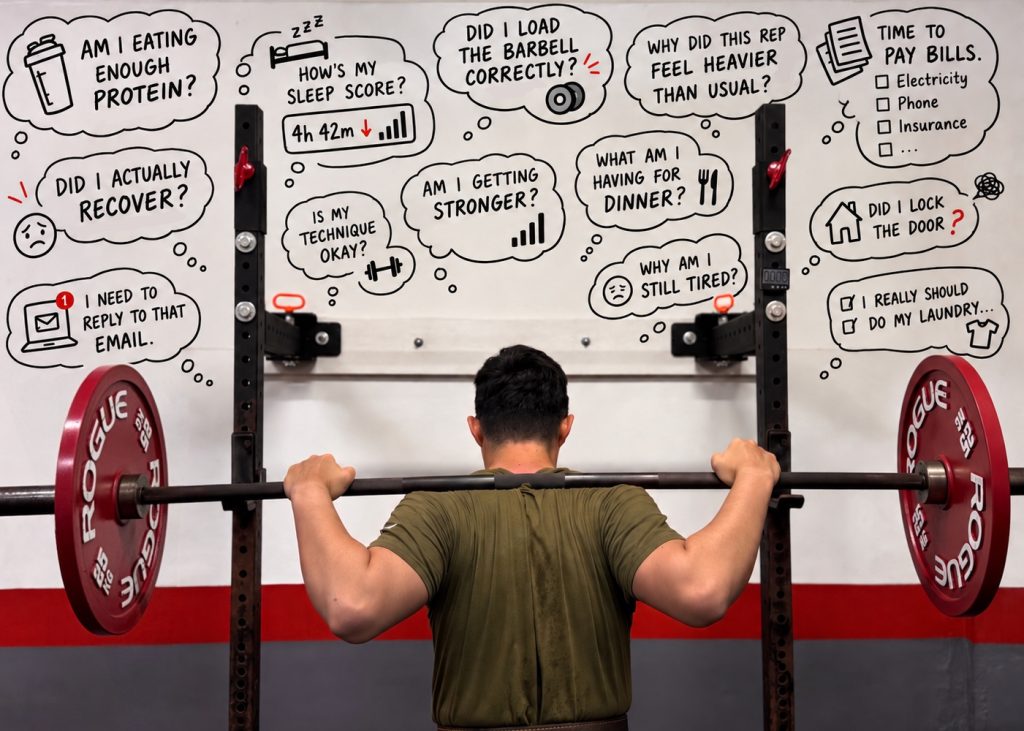
Don’t you wish the relationship between training and life’s various stressors could be quantified? Sometimes, you would expect a workout to go completely south because of poor sleep and a stressful day at work, only to walk into the gym and break a personal record. Other times, a fun dinner with hours of heartfelt conversation with your closest friends leaves you feeling happy and relaxed, only for the next day’s training to feel considerably harder than usual.
Recently, one of my clients came into the gym looking more exhausted than usual. She explained that she had been having a fantastic time with family members who had flown in for a week, but despite eating well and sleeping well, she felt oddly tired. We started the training session as usual, with the intention of at least attempting her heavy squat set. At the same time, I gave her the option of taking some weight off the program if that was what she needed to get through the rest of the session.
Three days later, during her next training session, we had a conversation about external stress and its potential impact on training. She wondered whether the additional stress of having family around, despite the experience being an enjoyable one, might have contributed to how she felt during the previous session. She also wondered whether heightened cortisol could have been part of the reason behind what she perceived as “stalled progress”. Evidently that was not the case, as she finished her program this time with no adjustments.
This conversation got me thinking about how differently stress can perceived. I’m sure you have heard people making sweeping absolute statements about their relationship with stress and performance. Some might declare that they only perform at their best when the pressure is high and sleep is scarce, while some have claimed to be hyper-sensitive to stress due to a nervous system “disregulation”, citing cortisol spikes and “fight or flight” triggers.
So where does the truth lie? Is there a point at which the accumulation of stress from training, work, relationships, lack of sleep or appetite, and everything else in life becomes too much for us to continue making progress?
The stress hormone
Cortisol is a hormone involved in the body’s response to elevated stress, but it is not a stress indicator that rises proportionately with every stressful thing that happens to us. It plays an important role in regulating metabolism and energy availability, and is involved in the regulation of immune and inflammatory processes (Youmshajekian, 2025). Cortisol also follows a natural daily rhythm, rising and falling at different times of the day.
Heightened cortisol levels have recently gotten a bad rep across social media, being misunderstood as the catabolic muscle-reducing, inflammation-inducing, bloat and puff devil hormone. If you squat, deadlift or perform a hard training session, your body needs to respond to the physical demands you have imposed on it. An acute stress response is part of that process. It only becomes problematic when people start taking a perfectly normal physiological response for poor recovery when their performance did not feel the same as they had expected (Youmshajekian, 2025).
Feeling stressed does not necessarily mean that cortisol is chronically elevated, or that you have somehow sabotaged your training. And a single measurement of cortisol cannot tell us whether you are going to have a better or worse training tomorrow. When any lifter states to be more stressed than usual, they may be referring to how they feel psychologically, or to the physiological response of difficult training session, or to poor sleep, accumulated fatigue or some other change in their health and routine. Sometimes that could be helpful indicators of what’s to come during the training, yet sometimes it will amount to no perceptible change in performance at all.
When one exercises, cortisol elevation is temporary as an acute response to physiological stress, at which the magnitude of increment is dependent on the intensity of the training. Increased cortisol sustains for a few hours post workout, and then returns towards resting concentration levels, along with normal fluctuations in cortisol that occur in response to exercise, sleep, nutrition and everyday stress (Hackney & Walz, 2013).
While it is true that a hard workout can temporarily raise cortisol, which is touted for its catabolic effects, it is vastly different when compared to the phenomenon of chronically elevated cortisol diseases (Egan & Sharples, 2023). Sustained hypercortisolism occurs when cortisol production or exposure remains abnormally high – such as with prolonged corticosteroid use or Cushing syndrome – and is associated with conditions including hypertension, diabetes, osteoporosis and cardiovascular disease (National Institute of Diabetes and Digestive and Kidney Diseases, n.d.). By then, you’d have other chronic health conditions to worry about before wondering if your RPE 10 workout is causing you too much stress and putting you into catabolism.
Life stress, training stress, same same but different
We train to get stronger. In order to do so, stress is applied to disrupt the body’s stable state of homeostasis. An appropriate amount of stress provides a reason for the body to adapt, provided there is sufficient recovery. Not enough stress, and there is little reason for adaptation. Too much stress, and the body may not be able to recover adequately from it, and therefore fails to produce the adaptation we are looking for.
This cyclical process of stress, recovery, and adaptation may sound applicable only to the physical demands of training, but over the years of my own training and coaching others, I have come to realise that our mental and emotional states can be influenced by how we approach training as we get stronger. Those who have stuck around long enough to see the weight on the bar increase understand that continued progress eventually requires more weight, and therefore causing more training stress. We adapt to the amount of training stress we can recover from, which constantly evolves as we get stronger.
Our lives are constantly filled with ebbs and flows: work demands, dinner plans, holidays and travel, sickness, changes in our sleep schedule, family commitments, relationship problems and everything else that inevitably happens outside the gym. These minor disruptions may not seem significant individually, but they can make the recovery process more challenging and add to the total demands on top of training.
We often describe these stressors as separate components – training stress, relationship stress, family stress, work stress – but there’s only one body handling all of it. There is no separate recovery system for the stress you experience at work and another one for the stress you experience under the bar. Different stressors may produce different physiological responses, but they all place demands on the same organism, and your capacity to recover from training depends on how well you’re taking care of your recovery variables.
More often than not, we are quick to underestimate what we can do because of the sheer amount of mental and emotional stress impacting us negatively, but a bad day at training with everything feeling heavier than usual is still markedly better than simply not training at all because “I’m too stressed for training”.
If training is stress, maybe no training = no stress?
Your body needs sufficient food, sleep and rest to recover from the demands being placed on it. When life becomes more demanding, that capacity may be reduced, and that’s could be how everything suddenly feels more stressful and difficult to navigate through. Though you can’t quit your job to reduce work stress, and you definitely should not stop training, so here are some recommendations you can consider for when life becomes high-stress:
1. Maximise your recovery variables
Sufficient sleep and a proper diet will go a long way in helping your recovery. Find ways to improve your sleep hygiene – no phones before bed, use sleep earplugs and eye masks, try melatonin, or change your bedding options. Feeding yourself adequately with a balanced and nutritious diet high in protein and fibre, healthy carbs and fats will do wonders for your body.
2. Repeat the training next week
Let’s say you were meant to do two sets of heavy triples, but only managed a set of two. Before making any huge adjustments to the program, you should repeat this exact training same time next week after trying to maximise your recovery variables. Chances are, you’ll probably feel fresher repeating the attempt.
3. Modify your training frequency and adjust training loads temporarily, adding back when normalcy resumes
Sometimes, squatting heavy and doing deadlift volume sets on the same day could feel dreadful and exhausting. Or, perhaps the idea of being at the gym training intensely for any more than 30 minutes starts to sound much more mentally demanding than usual. Speak to your coach about keeping the lifts heavy while reducing some volume to prevent detraining during a stressful period, with the intention of restoring previous training loads as soon as tough times pass. Splitting your training schedule up with an extra day of training can help with recovery, shortening each training session without depleting your energy.
Stress is not the enemy
Training stress is the most helpful form of emotional and mental regulation that can offer stability during difficult times. Emotional and mental stress may be out of your control, and its symptoms almost always affect the physical state. But remember, the one thing that can cause the greatest positive influence to your physical state is a stronger, able body, and that can be attained through the process of lifting heavier.
References:
1. Egan, B., & Sharples, A. P. (2023). Molecular responses to acute exercise and their relevance for adaptations in skeletal muscle to exercise training. Physiological Reviews, 103(3), 2057–2170. https://journals.physiology.org/doi/full/10.1152/physrev.00054.2021
2. Hackney, A. C., & Walz, E. A. (2013). Hormonal adaptation and the stress of exercise training: The role of glucocorticoids. Trends in Sport Sciences, 20(4), 165–171. https://pmc.ncbi.nlm.nih.gov/articles/PMC5988244/
3. National Institute of Diabetes and Digestive and Kidney Diseases. (n.d.). Cushing’s syndrome. https://www.niddk.nih.gov/health-information/endocrine-diseases/cushings-syndrome
4. Youmshajekian, L. (2025, March 13). Cortisol rises during intense workouts. Is that really a bad thing? National Geographic. https://www.nationalgeographic.com/health/article/exercise-effect-cortisol-level