
Last month, we spoke to a group of people who had come in to find out more about our gym. We presented to them the importance of strength and why the barbell is the best tool to get stronger. During the Q&A, one attendee asked me: “How long do we have to or should we train here with you?”
This isn’t the first time I’ve been asked this question. It usually comes from someone considering joining our gym for coaching, and they want to know what they’re signing up for. Is this a short, medium, or long-term commitment? Is this something where you join, learn, then go off to continue on your own? Or do you need ongoing coaching over the long term?
Well, it depends on what you’re after.
It might sound self-serving when I say that working with us long-term is the best thing you can do for your training, and it is, because you’ll have guidance and can tap on our knowledge and experience throughout. With that being said, training with us for a few months to learn how to lift safely and efficiently before heading off on your own is also a completely viable option.
We have a handful of clients who train with us for a couple of months before going off to continue on their own. But most of our clients have been with us for years. My longest-standing client has been training with me for almost 13 years. People stay because the value we provide changes as their training career progresses.
When you first start out, the coach’s value is in teaching you how to perform the basic barbell lifts, and fixing form deviations as they happen. We also know how to work around any issues or limitations you might have and make adjustments where necessary.
At this stage, programming is straightforward as you’ll be on the Novice Linear Progression program – a general strength training program that is simple but very effective. As you progress, the value shifts away from teaching and refining technique (though we never stop keeping an eye on it to prevent form creep) and moves more towards programming. The further along you are, the more individualised your program needs to be. We make changes based on what we observe as you’re lifting, what we’ve learnt works and doesn’t work for you, and on the knowledge and experience we’ve built up over the years.
Navigating the inevitable bumps with you
On top of that, we’re there to guide you when the inevitable bumps in the road occur. Injuries, pain, strains – we provide solutions to address the issue and work around the temporary limitation so you can keep training. This matters because every injury that occurs in the gym can and should be trained through, with appropriate adjustments. Contrary to what most people think, not stopping training while making the right accommodations speeds up recovery, leads to better outcomes, and prevents detraining.
If your schedule gets blown up by a crazy deadline, sudden business travel, or family commitments, we’ll find a way for you to keep making progress, or at least minimise the amount of detraining, with whatever time you have available.
Now, can you learn to train on your own? Of course you can. That’s exactly how we got to where we are today. By reading, learning, and practising on ourselves before going on to coach others and refining our skills over the years. Additionally, there has never been a better time to teach yourself, given how much information is out there and how easy it is to find it.
So why not just do it yourself?
If you enjoy the process of learning and figuring things out through trial and error, it can be genuinely rewarding process. But if you don’t have the time, don’t have the bandwidth to work through all the hows and whys, or simply can’t be arsed and just want to do it correctly right out of the gate, that’s where we come in.
Our role is to be the interface between you and the training methodology – guiding you toward what you want to achieve, drawing on our knowledge and years of experience working with a variety of people.
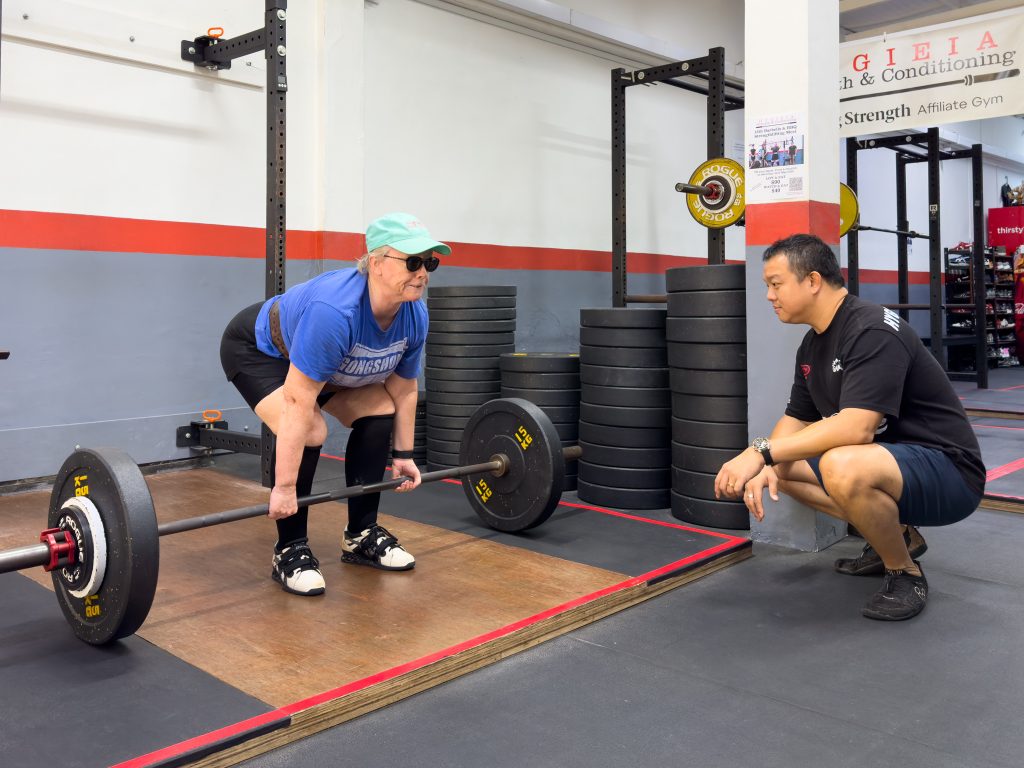
What we’re providing is time and effort saved. If you’re learning the barbell lifts on your own, you’ll need to apply what you’ve read and then identify and correct your own deviations from the model. The problem is that if you don’t know what you’re looking for, it’s hard to correct yourself. Forums and online feedback exist, but nothing beats immediate, in-person coaching. Issues get fixed as they happen, with objective feedback.
Stance width, grip width, back angle – corrected on the spot as it happens. Actionable cues you can implement immediately. When verbal or visual cues don’t work, we can use tactile cues or physically move you into the correct position. If there’s any discomfort or pain, we know how to adjust and work around it.
Programming changes are made pre-emptively, so you keep making progress instead of spinning your wheels in the gym and wondering why nothing is moving despite your best efforts. All of this can be learned on your own, but sieving through the overwhelming amount of information online and figuring out what works and what doesn’t takes a lot of time and effort.
Consistency and encouragement
To a lesser but still meaningful extent – having a coach increases the likelihood that you’ll train consistently, which is the single best predictor of making progress over the long term. It’s easy to skip a session when you only answer to yourself. Having a scheduled time where someone is expecting you makes it a lot harder to bail. And during heavy sets, having someone there to encourage you for that last rep you’re not sure you’ll get, or to keep you grinding through a rep you’re convinced isn’t moving even though it is, makes a real difference.
So, to sum it up – what we do is save you time and effort, and get you to where you want to be safely and efficiently. We’ve spent years accumulating the knowledge and experience so that you don’t have to figure it all out yourself.
If you want to get stronger, consider hiring a coach. It’ll be the best thing you do for your training.