
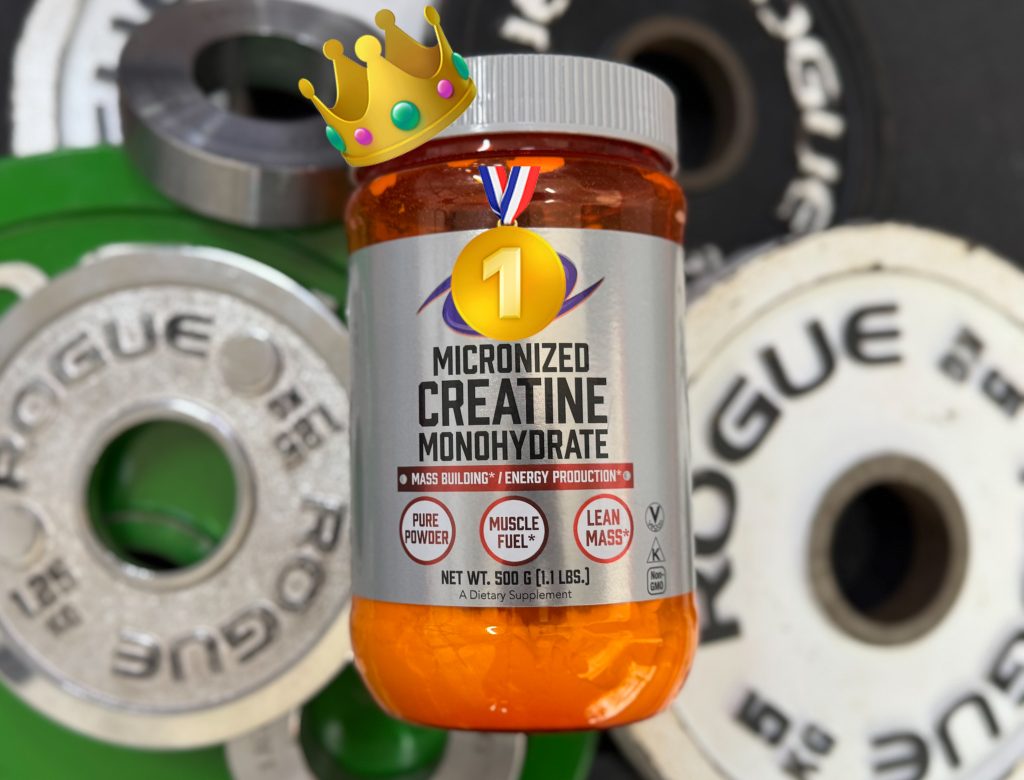
A few months ago, I wrote a short guide about supplements. In that article, creatine was briefly mentioned as the supplement everyone should jump onto immediately. It’s affordable, exceptionally well-researched, and honestly a no-brainer for anyone who trains for strength.
One of our clients took this advice and recently asked how she could switch up her creatine intake. She couldn’t tolerate the gritty texture of the powder on her palate, and the lack of flavour made it taste almost alkaline and deeply unappetising. Her solution? Switching to creatine gummies. At first, I thought nothing of it – after all, having something is better than having none at all. But then the question crept in: what if this processed version of the supplement is actually nothing more than a waste of money?
Turns out, I was right. Taking creatine in gummy form already makes it a more expensive daily supplement, thanks to all the additional ingredients – setting agents, flavourings, sweeteners, stabilisers. Worst of all, the cooking process subjects creatine monohydrate to high heat, causing it to convert into creatinine before it’s even consumed. Creatinine is merely a waste byproduct of creatine, making the product rather pointless.
This rabbit hole made me realise how little I truly knew about a supplement I’d been confidently slinging into everyone’s faces. So in this article, let me show you what creatine actually does for your body – and how you can best incorporate it into your daily routine.
What is creatine?
Creatine is a naturally occurring compound found mostly in skeletal muscle, with smaller amounts in the brain and other organs. Your body synthesises some of it on its own, while the rest comes from dietary sources such as red meat and fish. [1] It’s not a hormone, nor a drug, and definitely not a steroid. You can rest easy knowing that you won’t get accidentally jacked from this unassuming white substance.
Stored primarily in skeletal muscle, creatine functions as a key metabolic support compound. As a nitrogen-containing organic compound, it plays a crucial role in carrying and regenerating high-energy phosphate groups that are essential for short, intense bursts of muscular work. [2]
Why is it good for my training?
Your body is constantly tapping into energy systems to fuel movement as you interact with your environment. Shifting our focus particularly to strength training: imagine performing a set of heavy squats. With each rep feeling heavier than the last, you recruit every fibre you can to keep the moving bar. By the fifth rep, you’re huffing for air and scraping the bottom of the energy barrel.
That barrel is known as the anaerobic energy system, which relies on stored adenosine triphosphate (ATP) and phosphocreatine (CP). These molecules provide immediate energy in short bursts, but the supply is limited and gets depleted within seconds before it can be topped up again, which takes roughly 3 to 5 minutes. As ATP is used, it loses a phosphate group and becomes adenosine diphosphate (ADP). By the time you grind through the final rep, that tank feels empty because most of the readily available ATP has already been broken down into ADP. [2]
This is where creatine comes in. Think of it as an additional fleet of rickshaw pullers stored within muscles, each hauling a cart loaded with charged batteries. These batteries are phosphate groups (CP) ready to be donated back to ADP to regenerate ATP. The more rickshaw pullers you have, the more batteries can be delivered, and the faster ATP can be replenished.
In short, increasing creatine provides more energy for the skeletal muscles during demanding physical movements that require high force and rapid power production in a short amount of time. This helps to increase tolerance towards training volume and therefore bolsters strength development. [2]
From ingestion to excretion – creatine’s journey through your body
The supplement’s main task is to survive as creatine so it can get absorbed as-is, to provide good work in the muscles, and then leave the premises as creatinine. At no point should it convert into anything else before it can be put to use in the muscles.
In the gut:
Unlike proteins and carbohydrates, creatine does not (and should not) break down in the stomach. Interestingly, the compound stays largely intact and stable despite the acidic environment in an empty gut at pH 1-3, as studies have shown that creatine is most unstable at pH 3.5-5.5 (more on this later). In practical terms, standard oral doses of creatine monohydrate survive gastric digestion just fine. [3]
Absorption in the small intestines:
After passing through the stomach, creatine reaches the small intestine, where it is absorbed into the bloodstream via transport mechanisms in the intestinal lining. From there, it enters circulation and is distributed throughout the body.
Storage and usage in muscles:
Roughly 95% of the absorbed creatine is stored in skeletal muscles, with the remaining 5% stored in other organs such as the brain, liver, kidneys, and testes. Muscle cells either store it as free creatine or convert it into phosphocreatine (CP). [4] This storage pool is what supports rapid ATP regeneration during short, high-intensity efforts like sprinting, jumping, and that dreadful set of heavy squats. Muscle creatine storage is finite, though. Once your muscles are “full,” extra creatine doesn’t get stockpiled indefinitely – it simply circulates until it’s broken down and excreted. [4],[5]
Conversion to creatinine in the kidneys:
Creatine storage doesn’t stay in your system forever. A small percentage of stored creatine and phosphocreatine spontaneously degrades each day into creatinine, filtered out of the blood by the kidneys to be eliminated from the body through urine. [4]
Creatinine is useless for performance, but very useful clinically, which is why it is commonly measured as a marker of kidney function. It is worth disclosing your creatine intake to your doctor before blood or urine tests, as creatinine levels may appear elevated despite normal kidney function. [5]
Take Creatine, Not Creatinine!
Now that you understand how creatine travels through the body, choosing the right form of supplement should be straightforward. I’ve done the homework for you – it’s none other than creatine monohydrate. Being the cheapest, most stable and most researched form of this compound, there is no reason why you should spend more money on anything else that is less effective or more expensive. [2],[7]
Every other form – buffered creatine, liquid creatine, ethyl ester, “advanced blends” — exists for marketing and profit, not performance reasons. If it contains a laundry list of ingredients accompanying creatine monohydrate, put it back. Any other form of creatine with an unnecessary processing step or an extra ingredient always means extra cost, which is always borne by the consumer. Save your money and get the simplest one on the shelf!
Remember when I mentioned a few times in this article about the importance of creatine stability through absorption? Since creatine degradation increases when subjected to high heat and long exposure to acidic liquids [3], you’re better off not buying products like a beverage containing creatine or a gummy (which, allow me to remind you, was a cooked liquid before being set into a semi-solid candy).
My best recommendation to take creatine monohydrate is this:
• 3-5 grams per dose mixed thoroughly in a mouthful’s worth of water
• Down it like a shot
• Repeat daily. Timing of day doesn’t matter.
• Don’t fuss about the “loading phase”. Just start with one dose a day. [7]
If you must be so analytical about optimising your powder stash:
• Consume on an empty stomach, 90 minutes before a meal (food in the stomach increases gut pH, but the differential to creatine degradation is quite minimal)
• Avoid pre-mixing and leaving it hydrated in plain water for longer than 8 hours (which could accelerate degradation before absorption in the small intestines)
• If you must mix it with a slightly acidic beverage (coffee, orange juice) to mask the odd texture and flavour, make sure the beverage is consumed promptly. [3]
… and if you don’t follow these rules, the drop in efficacy is actually not significant enough to warrant action either. You’d have to be mixing it with a hot apple cider vinegar drink that was left simmering on the stove to render the creatine fully redundant. It’s more important that you stay consistent with taking it daily, along with a nutritious diet with proper protein intake, while being committed to training. Just don’t buy a hyped up product just because it’s flavoured or flashy.
Don’t think too much, just start and stick with it
The big picture here is that creatine can be a helpful training support tool that can provide a small boost to the strength training that you are consistently doing. By no means is it a magic powder, as it’s not a cure for fixing bad training or poor recovery. It’s simple, boring, and effective, just like good ol’ strength training. And, as usual, boring consistency always triumphs with results in the long run.
References:
[1] Peer-Reviewed Journal Article
Bonilla, D. A., Kreider, R. B., Stout, J. R., Forero, D. A., Kerksick, C. M., Roberts, M. D., & Rawson, E. S. (2021). Metabolic basis of creatine in health and disease: A bioinformatics-assisted review. Nutrients, 13(4), 1238. https://www.ncbi.nlm.nih.gov/pmc/articles/PMC8070484/
[2] Video / Online Content
Sullivan, J. M. (2019, December 23). Why Creatine is Good for Masters Lifters with Dr. Jonathon Sullivan [Video]. YouTube. https://youtu.be/D5xjMxR98hM
[3] Blog / Online Article
Moussa, A. (2011, August 28). Ask Dr. Andro: The pharmacokinetics of creatine (Part I/II) – How is creatine absorbed into the bloodstream? SuppVersity. https://suppversity.blogspot.com/2011/08/ask-dr-andro-pharmacokinetics-of.html?m=1
[4] Web Informational Article
Creatine and creatinine: Occurrence, biosynthesis and absorption. (n.d.). Biology Discussion.https://www.biologydiscussion.com/biochemistry/protein-metabolism/creatine-and-creatinine-occurrence-biosynthesis-and-absorption-protein-metabolism/43657
[5] Scientific Journal Article
Wallimann, T., Tokarska-Schlattner, M., & Schlattner, U. (2011). The creatine kinase system and pleiotropic effects of creatine. Amino Acids, 40(5), 1271–1296. https://link.springer.com/article/10.1007/s00726-011-0877-3
Book Chapter / Book
Sullivan, J. M., & Baker, A. (2016). Specificity and effectiveness: Your physiological 401k. In The Barbell Prescription: Strength Training for Life After 40 (Chapter 4, Chapter 16). The Aasgaard Company.